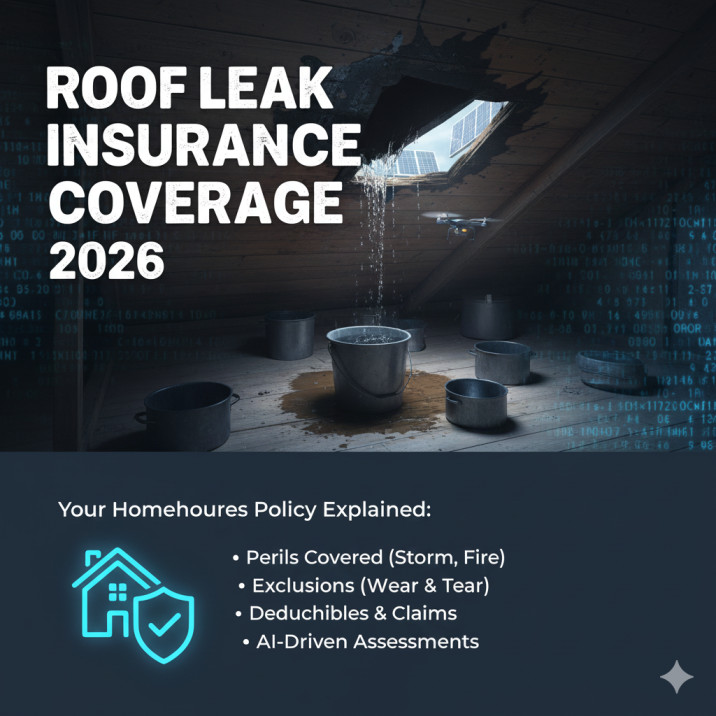
The roof is the single most critical line of defense for your home. When it fails, the results are immediate, costly, and stressful: a ceiling stain today, widespread mold tomorrow.
But as the cost of homeowners insurance skyrockets and carriers become increasingly stringent, the question every homeowner must ask is becoming more complicated: Does homeowners insurance cover roof leaks in 2026?
The short answer is the same as it has always been: It depends on why the leak occurred.
The long answer, however, is that the insurance industry’s approach to roof damage is hardening dramatically. Driven by escalating catastrophic weather claims, persistent construction inflation, and sophisticated aerial technology used for risk assessment, securing roof leak insurance coverage in 2026 requires meticulous planning, proactive maintenance, and an understanding of policy exclusions.
This guide breaks down the essential factors determining your roof leak insurance coverage 2026, explains the crucial distinction between sudden damage and neglect, and provides a clear strategy for successfully filing a claim in a volatile market.
The Golden Rule: Sudden, Accidental, and Unexpected Damage
Standard homeowners insurance (HO-3 policy) is designed to protect you from sudden, accidental, and unexpected damage. This principle is the key that unlocks coverage for a roof leak.
If your roof leak claim is to be approved in 2026, the cause of the damage must align with one of the “covered perils” listed in your policy.
When a Roof Leak IS Covered
Coverage is typically granted when the leak results from an event that is immediate and beyond your control. These are the most common scenarios that lead to successful claims:
- Sudden Weather Events: Leaks caused by named storms or severe weather that breaches a structurally sound roof.
- Wind Damage: High winds tear off shingles, creating an immediate breach.
- Hail Damage: Large hailstones crack tiles or compromise the waterproof membrane.
- Weight of Ice and Snow: Excessive buildup causes structural collapse or pooling that forces water into the structure.
- Falling Objects: A tree or a large branch punctures the roof immediately.
- Vandalism: Intentional damage to the roof structure.
- Fire: Structural damage caused by fire, or immediate water damage from firefighting efforts.
In these situations, the policy covers two things: repair/replacement of the roof section damaged by the covered peril, and the resulting interior damage (e.g., stained ceilings, damaged drywall, ruined insulation).
The Great Divide: When Roof Leak Coverage is DENIED
The vast majority of roof leak claims are denied because the insurer determines the cause was related to lack of maintenance, wear and tear, or gradual deterioration.
Exclusions That Will Deny Your 2026 Claim
This is where insurers have become stricter, focusing on negligence to limit payouts. In 2026, carriers will aggressively look for these exclusions:
- Wear and Tear (The Age Factor): If the leak occurred simply because the roof had reached the end of its useful life (brittle shingles, cracked flashing due to age), the claim will be denied. Insurers do not pay to replace old roofs.
- Lack of Maintenance/Neglect: If your leak is traced back to a clogged gutter, blocked downspout, or improper sealing that should have been fixed, the insurer will argue the damage was preventable.
- Faulty Design or Workmanship: If the leak stems from an improper installation (e.g., shingles laid incorrectly), the claim should be directed to the contractor, not your homeowners insurance.
- Mold and Rot (Gradual Damage): If water leaked gradually over time, causing extensive rot or severe mold growth, the insurer may deny the claim for the rot and mold remediation because the damage was gradual, not sudden.
The 2026 Technology Hurdle: Aerial Imagery
One of the greatest challenges for homeowners filing a claim in 2026 is the ubiquitous use of aerial technology. Insurance carriers are increasingly using high-resolution satellite, drone, and aerial imagery services to assess roof condition before and after a claim.
- Pre-Claim Assessment: Carriers visually inspect your roof for moss growth, missing granules, and deterioration – all signs of wear and tear—that occurred months or years before a storm. If they can prove the roof was already substantially deteriorated, they will deny the claim.
- Post-Claim Vetting: They use this data to precisely map the damage and compare it against the age of the roof in their records.
Understanding Depreciation: ACV vs. RCV Valuation
Even if your roof leak insurance coverage is approved, you need to understand how much the insurer will pay. This depends entirely on the valuation method used in your policy, a distinction that is critical in the 2026 market due to high construction costs.
1. Replacement Cost Value (RCV) — The Gold Standard
- What it Covers: RCV is what you want. The insurer pays the full, current cost to repair or replace the damaged property without deducting for depreciation.
- The Catch in 2026: Due to soaring building material costs, many carriers are moving away from offering RCV on older roofs. They may insist on an ACV policy or impose a specific Roof Schedule Depreciation Endorsement.
2. Actual Cash Value (ACV) — The Disappointing Reality
- What it Covers: ACV is the Replacement Cost minus Depreciation (based on the roof’s age and lifespan).
- The Math Example: If a new roof costs $20,000 and your 15-year-old roof is depreciated by 60%, the ACV payout is only $8,000. After your deductible, you are left covering the majority of the replacement cost out-of-pocket.
3. The Pro-Rata Depreciation Clause (The 2026 Trap)
Many policies in high-risk zones now include a clause that shifts the roof from RCV to ACV once it reaches a certain age (e.g., 10 or 15 years). Review your policy documents to see if your roof is specifically listed for Actual Cash Value coverage due to its age. This is the single largest reason for homeowner surprise during a claim.
Strategic Claim Planning: Securing Your 2026 Roof Coverage
Given the industry’s hardening stance, preparation is your best defense against a denied claim.
Step 1: Know Your Roof’s Status
- The Inspection: Have a certified, independent roofing contractor inspect your roof before you file a claim or renew your policy. Get a written report documenting its current condition and remaining lifespan.
- The Documentation: Keep all records of roof maintenance (gutter cleaning, moss removal, minor repairs). This is your evidence against a claim of “neglect.”
Step 2: Understand Your Policy’s “Fine Print”
Review the following key sections of your policy with your agent:
| Policy Term | What to Check | Why it Matters for 2026 |
| Wind/Hail Deductible | Is it a dollar amount or a percentage (1%, 2%, or 5%)? | A 2% deductible on a $400,000 home means an $8,000 out-of-pocket cost. |
| Roof Valuation | Is the roof RCV or ACV? At what age does it switch? | Determines if you get full replacement value or depreciated cash. |
| Ordinance or Law Coverage | Does the policy pay the added cost to rebuild to current building codes? | This coverage is essential if your old roof needs full tear-off to meet 2026 codes. |
Step 3: Act Immediately When a Leak Occurs
Time is the enemy of a successful claim. Insurers hate long, gradual damage.
- Mitigate Damage: Place buckets, cover furniture, and if safe, place a tarp over the damaged area. Homeowners have a duty to mitigate further damage.
- Document Everything: Take clear, timestamped photos and video of the cause (the hole, the missing shingle) and the effect (the ceiling stains, the damaged interior).
- Immediate Claim Filing: File the claim as soon as possible after the event. Waiting allows the insurer to argue that the damage worsened due to your delay.
The Proactive Approach: Maintenance and Technology
In 2026, the best way to secure Roof Leak Insurance Coverage is to prove you have done everything right.
- Proactive Maintenance: Clear gutters, check flashing around chimneys and vents annually, and trim tree branches back from the roofline.
- Leveraging Smart Home Technology: Place cheap, wireless water leak sensors in the attic (near vents and skylights) to alert you to a leak before it causes ceiling damage. This proves you were proactive and dramatically minimizes the interior claim cost.
Conclusion: The Final Verdict for 2026
The verdict on Roof Leak Insurance Coverage in 2026 remains nuanced but leans toward greater scrutiny.
- Coverage is Strong for CAT Events: If a tornado or hurricane rips open a brand new roof, your coverage is generally robust (subject to that high deductible).
- Coverage is Weak for Neglect: If an old roof leaks because of slow deterioration, the claim will almost certainly be denied or depreciated to near zero.
In the evolving homeowners insurance landscape of 2026, the homeowner must assume a greater responsibility for maintenance and documentation. Your best strategy is to treat your roof as a critical, expensive asset. Know its age, know its condition, and know the specific valuation clauses buried in your policy.
By being proactive, you shift the burden of proof back to the insurer, dramatically improving your chances of securing the full, fair coverage you deserve when disaster strikes.