Imagine this scenario: You’ve just finished a fantastic Saturday gathering. A friend, leaving your driveway, causes a devastating multi-car accident. They are severely injured, two other drivers sustain life-altering injuries, and property damage is extensive.
The ensuing legal action names you as a defendant because you hosted the gathering and served alcohol. The total damages claimed? $3.5 million.
You call your agent and receive the crushing news: your homeowners liability limit is $500,000, and your auto policy’s liability maxed out at $500,000. That leaves you personally responsible for $2.5 million. Suddenly, your hard-earned retirement savings, home equity, and future wages are all on the line.
This terrifying gap – the difference between your standard policy limits and real-world catastrophic liability – is exactly what Umbrella Insurance is designed to fill.
In today’s increasingly litigious and high-stakes world, the question is no longer “What if?” but “When?” As we look ahead to 2026, driven by soaring medical costs and rising jury awards, your need for this extra layer of protection is more urgent than ever.
This guide will explain exactly what umbrella insurance is, why your standard policies are insufficient, and – through real-world lawsuit examples – why it may be the single most crucial policy you can buy to protect your financial future.
What Exactly is Umbrella Insurance? (And Why the Name?)
Umbrella insurance is not a primary insurance policy. It is a form of excess liability coverage that sits above the liability limits of your existing primary policies, such as your homeowners, auto, and sometimes recreational vehicle or boat policies.
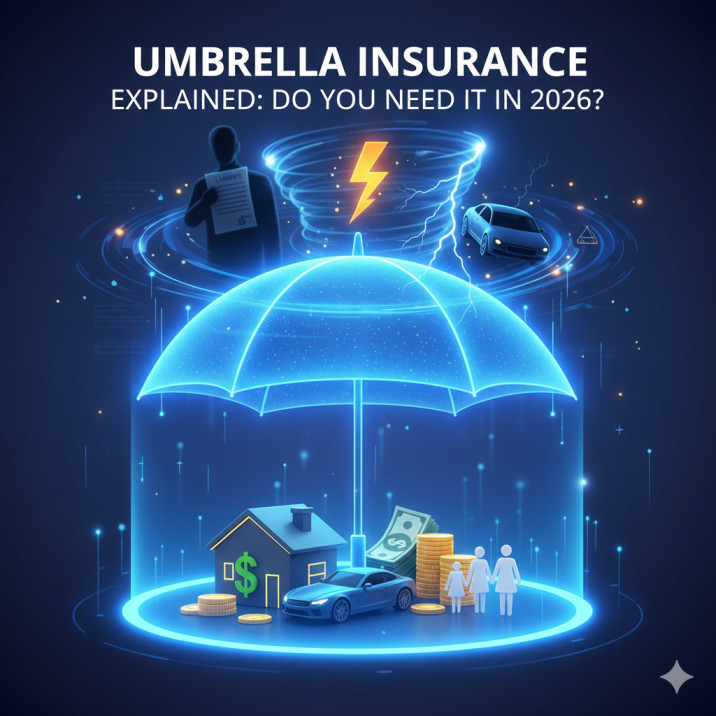
Think of it literally: It acts like a giant umbrella, shielding all your underlying assets from liability claims that exceed their respective limits.
The “Excess Liability” Structure
An umbrella policy is activated in two ways:
- When your underlying policy limits are exhausted: This is the most common use. If a judgment against you is for $1.5 million and your auto policy maxes out at $300,000, the auto policy pays the first $300,000, and the umbrella policy pays the remaining $1.2 million.
- When it covers things your primary policies exclude: Umbrella insurance often steps in to cover liabilities that your standard policies don’t, such as libel, slander, and false imprisonment (personal liability risks often stemming from social media use).
Key Features of Umbrella Coverage
| Feature | Standard Home/Auto Policy | Umbrella Policy |
| Coverage Limit | Typically $100,000 to $500,000 | Starts at $1 million, often up to $5 million or more |
| Cost | Included in policy premium | Surprisingly low: $150 to $300 per year for $1 million |
| Scope | Covers specific assets (car, house) | Covers your entire financial net worth (equity, savings, future wages) |
| Coverage Type | Property damage, bodily injury only | Bodily injury, property damage, plus personal liability (slander, libel) |
The Great Disconnect: Why Standard Limits Are Obsolete in 2026
When many policies were first written, the standard $250,000 or $500,000 liability limit was substantial. Today, those limits are dangerously inadequate, largely due to three economic and legal trends:
- The Skyrocketing Cost of Medical Care: The average cost of treating catastrophic injuries – spinal cord damage, traumatic brain injuries, or severe burns – now easily runs into the millions over a lifetime. Your $500,000 policy is exhausted almost immediately.
- The Rise of “Nuclear Verdicts”: A “nuclear verdict” is a jury award exceeding $10 million. These large, often emotionally driven judgments are becoming more common, increasing your catastrophic liability exposure.
- Digital Liability (The Social Media Trap): Liability can now start with a simple keyboard tap. Posting a damaging statement about a competitor or former employer can open you up to a defamation lawsuit. Standard policies rarely cover these “personal liabilities,” but umbrella policies often do.
Lawsuit Examples That’ll Scare You Straight
To fully appreciate the need for Umbrella Insurance Explained 2026, these real-world scenarios show how easily an everyday event can result in a devastating financial judgment against you.
1. The Multi-Car Pileup (The Auto Liability Trap)
Scenario: You cause a serious four-car pileup on the highway. Four people are seriously injured, one permanently disabled, and all four cars are totaled.
Total Claimed Damages: $4,750,000 (Including medical bills, lost wages, and pain/suffering).
The Gap: Your maximum auto liability is $500,000. Your policy pays $500,000. You are personally responsible for $4,250,000.
2. The Backyard Trampoline Disaster (The Homeowners Trap)
Scenario: A neighborhood child suffers a severe spinal injury resulting in partial paralysis while using your trampoline.
Total Claimed Damages: $5,850,000 (Including lifetime medical care, adaptive equipment, and lost quality of life).
The Gap: Your maximum homeowners liability is $300,000. Your policy pays $300,000. You are personally responsible for $5,550,000.
3. The College Kid Defamation (The Digital Liability Trap)
Scenario: Your college-age child posts a false and highly damaging accusation about a local business owner on social media. The business owner sues for defamation, citing massive loss of revenue.
Total Claimed Damages: $1,250,000 (Including lost business revenue and punitive damages).
The Gap: Your standard homeowners policy offers $0 for libel/slander. A $1 million umbrella policy would likely cover the entire defense and judgment.
4. The Landlord Liability Mishap (The Rental Property Trap)
Scenario: You deferred maintenance on a rental condo stair railing. A tenant’s elderly relative leans on it, it gives way, and they suffer a broken hip and severe head trauma.
Total Claimed Damages: $1,200,000 (Including treatment and age-related trauma).
The Gap: Your rental property liability limit is $500,000. Your policy pays $500,000. You are personally responsible for $700,000.
Do You Need Umbrella Insurance in 2026? A Financial Checklist
The need for umbrella insurance isn’t tied to your income; it’s tied to your net worth and your risk profile. If you lose a lawsuit, the plaintiff targets all assets not legally protected.
The Net Worth Rule
A common guideline is that if your net worth exceeds the liability limits of your homeowners and auto policies combined, you need an umbrella policy.
The Goal: You should own an umbrella policy that, at a minimum, equals your current net worth. This provides a layer of financial insulation against catastrophic loss.
The High-Risk Lifestyle Checklist
You should strongly consider it if any of the following apply to you in 2026:
- ✅ You own a swimming pool, trampoline, or aggressive dog breed.
- ✅ You own rental property, a boat, or an ATV.
- ✅ You drive more than 15,000 miles per year (statistically increasing accident risk).
- ✅ You volunteer, serve on a non-profit board, or coach youth sports (increasing liability exposure).
- ✅ You or a family member frequently use social media in a controversial or professional capacity.
- ✅ You have a high-profile, high-income career (making you a more attractive target for plaintiffs).
The Value Proposition: The Cost of Peace of Mind
The most appealing aspect of umbrella insurance is the sheer amount of protection you receive for a minimal investment.
Typical Annual Cost for $1 Million in Coverage
| Factor | Annual Cost Estimate |
| $1 Million Coverage | $150 – $300 |
| $2 Million Coverage | $250 – $400 |
| $5 Million Coverage | $500 – $800 |
For less than the price of a monthly streaming subscription, you can secure millions of dollars in protection. This makes umbrella insurance arguably the best value in the entire insurance market.
The Catch: Underwriting Requirements
To qualify, you must maintain high “underlying limits” on your home and auto policies (e.g., $250,000/$500,000 for auto and $300,000 for homeowners). This ensures the umbrella policy is reserved for true catastrophic events.
2026 Legal Trends: The Final Push for Umbrella Coverage
As we navigate the next few years, three trends make umbrella insurance increasingly vital:
- Litigation Inflation: The cost of filing and defending lawsuits has risen sharply. An umbrella policy typically covers all legal defense costs – including retaining lawyers, expert witnesses, and court fees – even if the case is dismissed.
- Autonomous Vehicle Liability Shifts: The transition to semi-autonomous driving features is creating complex liability questions. You need broad coverage that handles complex, multi-party litigation, which an umbrella policy provides.
- Increased Gig Economy Exposure: If you use your car for ride-sharing or your home for short-term rentals, your standard policies often exclude commercial activity. An umbrella policy can provide a final, crucial layer of protection when those commercial policies are exhausted or deny a claim.
Conclusion: Don’t Risk Your Financial Future
Umbrella insurance is not just for the wealthy; it’s for anyone who owns assets, earns an income, or engages in life’s normal, everyday activities.
In a world where medical costs skyrocket and jury awards regularly exceed seven figures, your standard auto and homeowners policies are merely a baseline defense. Without the excess liability provided by an umbrella policy, you are leaving your savings, your retirement, and your home equity directly exposed to catastrophic loss.
Don’t wait for a moment of distraction, a faulty step, or an ill-advised social media post to teach you the cost of liability. For a few hundred dollars a year, you can secure the peace of mind that protects everything you have worked so hard to build.
Action Step: Call your current homeowners or auto insurance provider today and ask for a quote for a $1 million or $2 million umbrella policy. You will likely be surprised by how affordable true financial security can be.