Most comparisons of identity theft protection services start with features and pricing. This one is going to start with something that matters more: what you’re actually protecting against, because the answer has changed significantly since most of these services were designed — and the scale of the problem in 2026 is large enough that treating this as an optional subscription you might get around to eventually is a decision with measurable financial consequences.
American adults lost $47 billion to identity fraud in 2024, according to AARP — and from 2020 to 2024, losses from online scams jumped from under $4 million to over $16 million annually, a trajectory that shows no sign of reversing. Those are not distant, statistical harms. They are the accumulated losses of people who discovered their Social Security number had been used to open a mortgage, their credit score had collapsed from accounts they didn’t recognise, and their tax refund had been redirected to someone else’s account. The recovery process, as explored in our piece on whether homeowners insurance actually covers identity theft and what it pays for when it does, takes an average of 210 hours and over $1,400 out of pocket even for cases that don’t involve litigation. Identity theft protection services exist to shorten that process, reduce those costs, and — when the monitoring component works — to catch the problem before the damage accumulates.
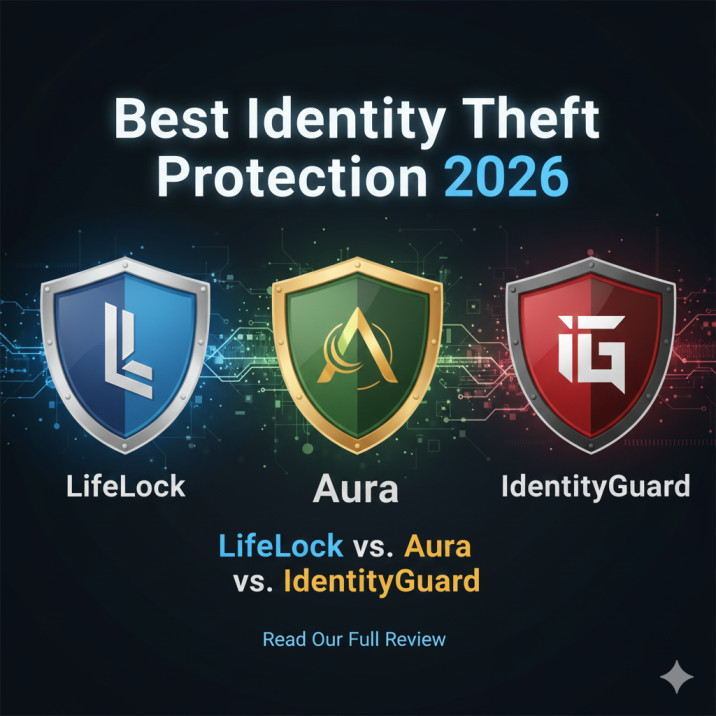
The three services that appear consistently at the top of independent testing in 2026 are LifeLock, Aura, and Identity Guard. They are not interchangeable, and the one that’s right for you depends on what you’re primarily protecting against and how much you want to pay. What follows is an honest account of how they actually compare — not a restatement of their marketing materials.
LifeLock: The Benchmark, With Caveats
LifeLock has been in the identity protection market since 2005 — longer than any major competitor — and its brand recognition reflects that history. In 2022 it officially became part of Gen Digital (formerly NortonLifeLock), giving it a connection to one of the most established names in consumer cybersecurity. LifeLock is rated the top identity theft protection service of 2026 by Security.org — affordable, feature-rich, and comprehensive with plans starting at $8.33 per month — with a 4.8 Trustpilot rating from customers and a “comprehensive” endorsement from PCMag. Those are legitimate strengths.
The caveats are also real. LifeLock’s history includes a $12 million FTC fine for misleading advertising — a settlement that resulted in stricter claims-substantiation requirements the company has since operated under — and its tiered pricing structure, while flexible, means that the features most people actually want when they research identity theft protection are not available at the entry-level price point. LifeLock’s entry-level Identity Advisor plan starts at $3.33 per month but includes only dark web and data breach notifications plus identity restoration help — with full financial account monitoring and three-bureau credit monitoring reserved for the higher-tier Advantage and Ultimate Plus plans. If you’re comparison-shopping on price alone and comparing LifeLock’s entry plan to Aura’s equivalent tier, you are not comparing equivalent products.
At its highest tier, LifeLock Ultimate Plus is genuinely distinctive. The insurance ceiling — $1 million each for stolen funds, legal fees, and personal expenses, giving a combined maximum of $3 million — is the highest available from any mainstream identity protection service and is the primary reason to choose LifeLock for policyholders whose primary concern is financial backstop rather than monitoring. Social media monitoring, also available only at the Total/Ultimate Plus tiers, is a feature Aura does not offer at any tier. And LifeLock’s U.S.-based restoration specialists — dedicated staff who handle the credit bureau disputes, creditor communications, and agency correspondence that make identity recovery so time-consuming — are consistently well-reviewed in independent testing.
The main difference between LifeLock and Aura is that LifeLock focuses on identity and scam protection with optional additional cybersecurity features, while Aura bundles cybersecurity features directly into its identity products — with LifeLock’s tiered structure meaning you’re only paying for the protection you actually need, but requiring more navigation to understand which tier delivers which features. That navigation complexity is a genuine friction point. Consumers who don’t read the feature tables carefully can end up on a plan that doesn’t include what they assumed they were getting — a problem Aura’s simpler structure avoids.
Aura: The Modern All-In-One Challenger
Aura was founded in 2014 — a decade after LifeLock — and has grown rapidly enough that as of February 2026, it holds the top ranking from Security.org, Forbes, CNET, TechRadar, and NerdWallet simultaneously. Aura provides true all-in-one protection plans with transparent pricing, faster fraud alerts, and more family safety options than LifeLock — with three-bureau credit monitoring included in every plan at all price tiers, not just premium subscriptions. That single structural difference — three-bureau credit monitoring universally included — is the most important feature distinction in the LifeLock/Aura comparison for most consumers, because it’s the monitoring function that catches the most common forms of identity fraud earliest.
The all-in-one model extends through the entire Aura subscription. Every plan includes antivirus software, a VPN, a password manager, an email alias for burner accounts, and — particularly valuable — a data removal service that actively requests your personal information be removed from data broker databases. Aura also monitors the most unique pieces of personal data on the dark web when compared to other leading identity theft protection providers as of March 2026, with AI-driven fraud detection and home plus auto title monitoring included in the standard subscription — with the family plan at $22 per month covering the widest attack surface of any service independently tested. Home and auto title monitoring is underappreciated as a feature. Deed fraud — where a fraudster transfers property title out of your name using forged documents — is a growing attack vector that standard credit monitoring doesn’t catch.
The honest weakness is the Trustpilot disparity. LifeLock holds a 4.8–4.9 Trustpilot rating compared to Aura’s 4.1 stars as of March 2026 — a meaningful gap in customer satisfaction that the feature count and editorial ratings don’t fully explain. Some of that gap reflects Aura’s lower-rated customer support performance in independent testing; some reflects the experience of users who discovered coverage limitations they hadn’t anticipated. And there is the breach incident: Aura suffered a data breach that exposed around 900,000 customer records, primarily names and email addresses, stemming from a phishing attack targeting an employee. The information exposed was contact data rather than financial credentials, and Aura disclosed the breach, but an identity theft protection service experiencing a breach is a legitimate concern that consumers should factor into their decision.
The data broker dimension of Aura’s proposition connects directly to our analysis of the data rights economy and who controls the personal information that flows through commercial platforms — because Aura’s data removal service is, functionally, attempting to do manually what the data broker ecosystem is continuously undoing automatically. LexisNexis, Verisk, and hundreds of smaller brokers rebuild consumer profiles from public records continuously. Data removal services slow the accumulation rather than stopping it, but the reduction in exposure is documented and meaningful.
Identity Guard: The Legal Muscle That Reviewers Underweight
Identity Guard is the least visible of the three services in mainstream comparison articles, partly because its interface and app design feel less polished than Aura or LifeLock, and partly because its marketing is less aggressive. Identity Guard includes unlimited consultation with licensed attorneys for identity theft legal issues in the base subscription — not an add-on — with licensed private investigators handling restoration cases and providing more aggressive pursuit of fraud sources than standard customer service agents, and three-bureau credit monitoring included at the base $14.95 per month price with no stripped-down entry tier. The attorneys and investigators are the differentiating features, and for anyone who has experienced complex identity theft — the kind that involves fraudulent accounts surviving multiple dispute cycles, debt collections, or court judgments — the value of having a licensed attorney available without additional cost is substantial.
Identity Guard uses IBM Watson-powered risk scoring for threat assessment, though the practical difference between Watson-powered pattern detection and the AI systems used by Aura and LifeLock is difficult to measure from the consumer side — with Identity Guard not publishing detection rate comparisons or independent audit results. That transparency gap is a genuine criticism. In a market where you’re comparing monitoring systems you cannot directly audit, the absence of published detection benchmarks makes the “IBM Watson” branding somewhat difficult to evaluate against competitor claims.
The honest weakness is the interface. Identity Guard’s mobile app and dashboard feel dated compared to Aura and LifeLock, with slower alert delivery and less intuitive navigation. For anyone whose primary interaction with the service will be through their phone, this matters practically. If you’re going to act on an alert quickly, the alert needs to arrive quickly and the action interface needs to be usable under stress. Identity Guard’s slower alert delivery is a documented limitation that the attorney access doesn’t fully compensate for in time-sensitive fraud scenarios.
The smart home data angle is worth raising here. As we examined in our analysis of how IoT devices and smart home gadgets create data collection and security vulnerabilities, the attack surface for identity thieves in 2026 includes not just financial accounts and email but the connected device ecosystem of the home — which is generating credential data, location history, and behavioural patterns that can be exploited via phishing, brute force, and social engineering at a scale and sophistication that outpaces consumer awareness. Identity theft protection services that include dark web monitoring catch credentials after they’ve been exposed in breaches. Services that include device security tools — Aura is the strongest here — address the earlier stage of the attack chain where credentials are being compromised.
The Framework for Choosing Between Them
Rather than a single “winner,” the right answer depends on what you’re most worried about and what you’re willing to pay. The logic breaks down into three scenarios.
If your primary concern is financial insurance backstop — the maximum coverage available if things go badly wrong — LifeLock Ultimate Plus at $34.99 per month is the choice. The $3 million insurance coverage across stolen funds, legal fees, and personal expenses is the highest available from any mainstream identity protection service, and the U.S.-based restoration specialists with dedicated case management are consistently rated among the best in the industry. You’re paying for a premium product and receiving one.
If your primary concern is comprehensive monitoring at the best value — particularly for a household with multiple family members — Aura at $22 per month for families is the strongest choice. Three-bureau credit monitoring at every tier, dark web monitoring covering the widest data-type scope independently tested, AI fraud detection, and the data removal service addressing the broker ecosystem that makes re-theft so common — all in one subscription without tier-gate surprises.
If your primary concern is robust recovery support when complex fraud occurs — accounts that don’t respond to standard dispute cycles, situations where aggressive investigation matters — Identity Guard’s licensed attorney and private investigator access justifies the less polished interface and slower alerts for the subset of theft victims whose cases involve genuine legal complexity. Identity Guard, Aura, and IdentityIQ consistently appear as the strongest alternatives to LifeLock when the evaluation prioritises depth of remediation support over breadth of monitoring features.
The cyber insurance intersection is also worth mapping clearly. Identity theft protection services are not cyber insurance, and cyber insurance is not identity theft protection. Our analysis of what cyber insurance for remote workers and personal device users actually covers in 2026 clarifies the coverage landscape — and the practical takeaway is that the services described above handle monitoring and restoration, while insurance products handle reimbursement of financial losses. For individuals with significant financial exposure, the optimal posture in 2026 is a monitoring service (Aura or LifeLock at an appropriate tier) plus an identity theft endorsement on a homeowners or renters policy — two layers that address two different dimensions of the same risk.
The attention economy angle is also relevant to how you research these services. Our piece on how tech platforms and algorithmically curated content affect your ability to make deliberate decisions applies here: many identity theft protection services are heavily marketed through fear-based content that exploits exactly the attentional dynamics that make consumers most susceptible to purchasing decisions driven by anxiety rather than analysis. The service that runs the most alarming advertisements is not necessarily the most protective one.
Frequently Asked Questions
Security.org, which tested more than 20 identity protection services independently, rates LifeLock as the top identity theft protection service of 2026, while simultaneously rating Aura as the top choice specifically for credit protection and all-in-one coverage. The distinction matters: LifeLock offers stronger insurance coverage (up to $3 million on the Ultimate Plus plan) and is rated higher by Trustpilot customers (4.8–4.9 stars vs. Aura’s 4.1 stars), while Aura includes three-bureau credit monitoring at every plan tier, covers more unique dark web data points, and bundles cybersecurity tools (VPN, antivirus, password manager, data removal) into every subscription. As of February 2026, Aura holds the top ranking from Forbes, CNET, TechRadar, and NerdWallet simultaneously. The “best” choice depends on your priority: LifeLock for maximum insurance, Aura for broadest all-in-one monitoring value, Identity Guard for legal and investigative restoration depth.
The primary structural difference is that LifeLock uses a tiered model where features are unlocked at higher price points, while Aura includes its core features — three-bureau credit monitoring, dark web monitoring, VPN, antivirus, password manager, and financial account alerts — at every plan tier. LifeLock’s entry plan starts at $8.33 per month but does not include three-bureau credit monitoring or full financial account monitoring; those require the $20.00 or $34.99 per month tiers. Aura’s individual plan starts at approximately $12 per month with three-bureau monitoring included. LifeLock’s unique advantages are its higher insurance ceiling ($3 million vs. Aura’s $1 million per adult), social media monitoring available at premium tiers, and a longer operating history (since 2005). Aura’s unique advantages are transparent all-inclusive pricing, home and auto title monitoring, a data removal service that addresses the broker ecosystem, and AI-driven fraud detection rated faster than LifeLock’s in independent testing.
No identity theft protection service prevents identity theft — they monitor for signs that your information has been exposed or misused, alert you as early as possible, and support the recovery process when theft occurs. The prevention layer available to consumers is separate from the protection service and includes: freezing your credit with all three bureaus (free, available any time at each bureau’s website), which prevents new accounts from being opened in your name; using strong unique passwords managed through a password manager; enabling multi-factor authentication on financial and email accounts; and monitoring your LexisNexis Consumer Disclosure Report annually at consumer.risk.lexisnexis.com. Identity theft protection services significantly reduce the cost and time of recovery, and their dark web monitoring can provide earlier warning of credential exposure than self-monitoring typically achieves — but they are a response mechanism rather than a prevention one.
Identity Guard’s primary differentiators are its licensed attorney access and licensed private investigator restoration support, both included in the base subscription. Unlimited consultation with licensed attorneys for identity theft legal issues — available without additional fees — is not matched by either LifeLock or Aura at any tier. Licensed private investigators handling restoration cases provide more aggressive and legally sophisticated pursuit of fraud sources than the customer service restoration specialists offered by competitors. This matters most for complex identity theft cases involving accounts that survive multiple standard dispute cycles, fraudulent tax filings, or identity fraud that has resulted in debt collections or judgments. Identity Guard also includes three-bureau credit monitoring at the base price of $14.95 per month, with no stripped-down entry tier. The documented weaknesses are a dated interface, slower alert delivery than Aura or LifeLock, and the absence of published detection rate comparisons that would allow direct performance benchmarking.
Yes — they address different dimensions of the same risk and are complementary rather than redundant. A homeowners identity theft endorsement (typically $25–$60 per year from insurers like State Farm) reimburses the recovery expenses you incur after theft — attorney fees, lost wages, document replacement costs — up to the policy limit, typically $15,000–$50,000. It does not monitor your credit, alert you to dark web exposure, remove your data from broker databases, or provide the restoration case management that dedicated identity theft protection services include. An identity theft protection service provides the monitoring and early detection that the homeowners endorsement doesn’t, while the endorsement provides the financial reimbursement that a standalone protection service’s insurance tier might cap at a lower amount than your exposure warrants. The optimal combination for most consumers is a monitoring service at the appropriate tier plus an identity theft endorsement — the monitoring catches problems early, and the insurance covers the costs of fixing them.
The Bottom Line
Identity theft protection is not a product category where the cheapest option is likely to be adequate, and it’s not one where the most expensive option is automatically the best. The service worth paying for is the one that matches your specific threat profile — whether that’s maximum insurance coverage, the broadest monitoring scope at a family-friendly price point, or the most aggressive recovery support for complex fraud scenarios.
LifeLock is the top identity theft protection service for families who prioritise insurance depth and U.S.-based restoration support; Aura is the top choice for families who want comprehensive all-in-one protection at transparent pricing; and Identity Guard is the strongest option for individuals whose primary concern is legal and investigative recovery muscle. None of the three is the wrong choice for its appropriate use case. The wrong choice is doing nothing, in a year when American adults lost $47 billion to identity fraud and the attack vectors generating those losses are more sophisticated and more AI-assisted than at any point in the category’s history.