Imagine waking up to find your phone showing “No Service.” You restart the device, toggle airplane mode, pull out and reinsert the SIM card, and assume it’s another one of those inexplicable MTN or Airtel network moments that every Nigerian has learned to endure with patience. What you don’t know — what you can’t know in that moment — is that the signal is gone because someone has just walked out of a telecom service centre holding a freshly activated SIM card registered to your number. By the time you realise what’s happening, your bank accounts may already be draining through USSD transfers, your email password has been reset through the OTP sent to your hijacked number, and your WhatsApp has been migrated to a device you’ve never touched.
This is not a hypothetical. In Nigeria, where your phone number is the master key to your Bank Verification Number, your USSD banking codes, your fintech wallets, and your identity verification infrastructure, SIM swap fraud has evolved into what the CBN and NCC have formally described as one of the dominant threat vectors in the Nigerian digital economy. NIBSS data shows 67,518 digital payment fraud incidents in 2025, even as total losses fell to ₦25.85 billion — down 51% from the year before — with the National Institute for Legislative and Democratic Studies flagging in January 2026 that SIM swap fraud, phishing, and insider collusion “remain dominant threat vectors” despite the aggregate improvement. The decline in aggregate losses is genuinely welcome — but the 13% rise in quarterly fraud losses from Q4 2025 to Q1 2026 suggests the criminal ecosystem is adapting faster than the systems designed to stop it. For individual Nigerians, the right response is not to wait for the systemic fix to arrive. The right response is to act now.
How SIM Swap Fraud Actually Works in Nigeria
Understanding the attack mechanism is the prerequisite for protecting against it, because most prevention advice fails to explain why simple measures like “just use 2FA” are insufficient when the attacker has already controlled the number those one-time passwords are being sent to.
The primary attack method is impersonation. A fraudster walks into a telecom service centre — or calls a customer care line — with fake or manipulated identity documents and claims their SIM has been lost or damaged. They request a replacement. If the verification process is inadequate, or if a telecom staff member has been bribed or coerced into skipping steps, the fraudster’s new SIM activates. Your SIM goes dead. The Nigerian Communications Commission’s Computer Security Incident Response Team (CSIRT) has explicitly warned that “criminal actors are using SIM swap attacks to steal millions from the public, sometimes by paying off telecom staff” — with insiders who approve fake SIM replacement requests identified as a critical enabler of the fraud at scale. The insider threat is not an occasional anomaly. It is a structural feature of how SIM swap fraud operates in Nigeria.
The second mechanism is quieter and less discussed: recycled phone numbers. If a mobile number has not been used in a few months, carriers may deactivate it and assign it to someone else — and that recycled number, now in the hands of a stranger, may still be linked to banking profiles or recovery emails, creating conditions for unintentional but real identity theft. If you have an inactive number that is still registered as your recovery number on your email account, your fintech app, or your bank OTP channel, a new subscriber assigned that number inherits access to your verification pathway. This is a risk that requires no criminal impersonation — just inactivity on your part and a standard telecom reassignment.
Once a fraudster controls your number, the sequence moves quickly. They dial USSD codes linked to your BVN — *737#, *901#, or other bank-specific codes — to check balances and initiate transfers using your phone number as the authenticator. They intercept OTPs sent by your bank, your fintech platforms, and your email provider to confirm transactions and reset passwords. The fraudster bypasses two-factor authentication for banking apps and email accounts, gaining complete control within minutes of the SIM activation. The window between the SIM activation and a Nigerian victim noticing the “No Service” state and acting on it is the window in which everything happens. A rise in quarterly fraud losses from ₦4.08 billion in Q4 2025 to ₦4.59 billion in Q1 2026 — a 13% increase — suggests that fraudsters are getting faster and more efficient, not slower. Time, in a SIM swap attack, is the only resource that matters.
What Nigeria’s Regulators Are Doing in 2026
The regulatory response in 2026 represents the most significant structural intervention against SIM swap fraud in Nigerian history, and Nigerians should understand what’s being built — both because it will eventually provide meaningful protection and because understanding its current limitations clarifies why personal action remains necessary right now.
The centrepiece is the Telecom Identity Risk Management System — TIRMS — born from a memorandum of understanding between CBN Governor Olayemi Cardoso and NCC Executive Vice Chairman Dr Aminu Maida. TIRMS is designed to let banks and fintechs check in real time whether a phone number tied to a transaction has recently been swapped, flagged for suspicious activity, or gone inactive — shutting the exact window that fraudsters have exploited between a successful SIM swap and a bank noticing anything is wrong. This is infrastructure that has not previously existed. Banks and telecoms have operated in separate data silos, which meant that a fraudster could complete a SIM swap at an MTN counter and drain a GTBank account before any connection between the two events was detectable. TIRMS creates that connection.
Running alongside TIRMS is a CBN directive that Nigerians using digital banking will already be experiencing: a device-binding requirement, taking effect July 1, 2026, requiring financial institutions to bind customer accounts to specific registered devices rather than trusting the phone number alone as a stand-in for identity. If your bank has recently asked you to verify your registered device, or if your banking app has prompted you to re-register your phone, this directive is the reason. Device binding means that even if a fraudster controls your number, transferring funds through a banking app requires authorization from your registered device, not just an OTP delivered to your number.
The NCC has also introduced biometric verification as a mandatory requirement for SIM swaps — meaning that requesting a SIM replacement without in-person biometric verification should now be impossible through legitimate channels. The practical limitation is enforcement: the quality of biometric verification varies across telecom service centres, and the insider collaboration risk means that procedural requirements don’t eliminate risk when the person enforcing them is complicit. These measures reduce the attack surface meaningfully. They don’t eliminate it.
The data rights dimension is also advancing. The Nigeria Data Protection Commission is drafting a new Digital Identity Protection Framework designed to help citizens claim compensation when their data is misused in identity theft and SIM swap scenarios. For Nigerians who have already experienced SIM swap fraud, this framework will eventually create a formal redress mechanism. For everyone else, it’s a signal that the data generated by your phone number, BVN, and NIN — the same data explored in our analysis of the data rights economy and who controls your financial information — is increasingly recognised as sensitive personal property with associated protection rights.
Your 7-Step Protection Plan Right Now
The TIRMS infrastructure and device binding directive are coming. In the meantime, these seven actions represent the highest-impact personal protection available to every Nigerian in 2026 — none requiring technical expertise, all executable today.
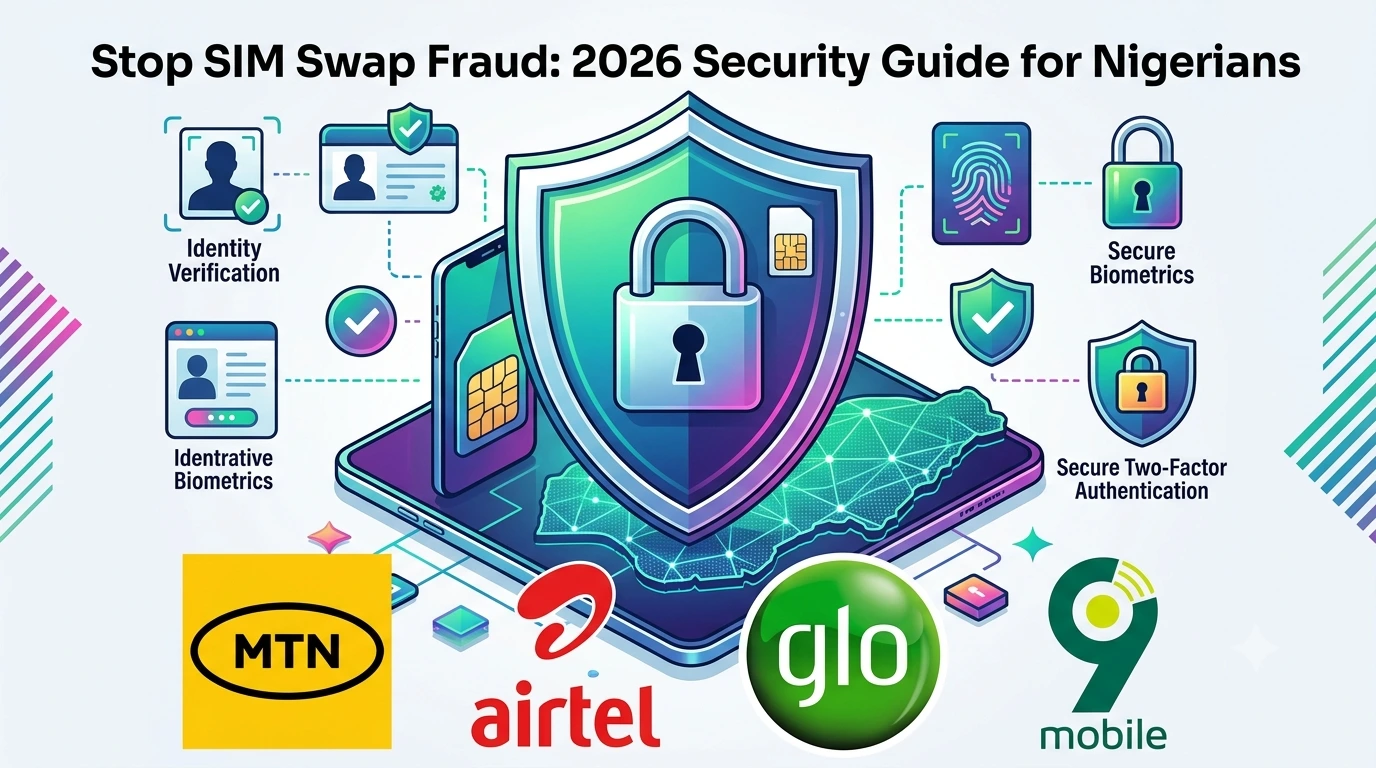
Step 1: Set a SIM Lock PIN at Your Telecom Provider. Visit an MTN, Airtel, Glo, or 9mobile service centre and request that a SIM lock PIN be placed on your line. This means any SIM replacement request for your number requires the correct PIN before it proceeds. This single measure directly addresses the in-person impersonation attack at the point where it’s most vulnerable. Do not do this through a third party or agent — go to an official branded service centre.
Step 2: Switch Away From SMS-Based OTP Where Possible. Because a SIM swap gives the attacker control of every SMS OTP sent to your number, any banking security relying solely on SMS is vulnerable the moment the swap succeeds. Check whether your bank offers authenticator app login (Google Authenticator or Microsoft Authenticator) and enable it. Remove your phone number as the sole recovery method on your email accounts.
Step 3: Register Your Device With Your Bank Immediately. The CBN’s July 1, 2026 device-binding directive requires banks to implement this, but you should proactively register your primary phone as your authenticated device on every banking and fintech app you use. This means that even if a fraudster has your number and your OTP, initiating transfers from an unregistered device should trigger an additional authentication step.
Step 4: Know Your Emergency Bank Freeze Code. Every major Nigerian bank has a USSD emergency block code that can freeze your BVN-linked account from any phone. The moment you suspect your SIM has been swapped — if your phone loses service unexpectedly — your first action should be to call or borrow a phone and dial your bank’s emergency block code. The NCC and CBN have both advised that if your phone suddenly stops getting signals, do not wait and do not assume it is just a network issue — check your bank app immediately from any available device and notify your telecom provider and bank without delay. Know your bank’s code before you need it.
Step 5: Never Share Your NIN, BVN, or Any OTP. This sounds obvious until the caller knows your name, your account balance, and your last three transactions — which the insider who facilitated the SIM swap may have provided. Nigerian fraudsters operate in networks. The person calling to “verify your details” after your phone loses service may have information that sounds legitimate. No bank employee and no NCC representative will ever need your BVN, your NIN, your PIN, or an OTP you just received.
Step 6: Protect Your Active Numbers, Even Unused Ones. The recycled number threat means that a number you’re not actively using but that is still registered on banking platforms, fintech apps, or email recovery is a vulnerability. Either actively maintain the number with occasional usage or remove it from any financial service where it serves as a verification channel.
Step 7: Report Immediately and Completely. If SIM swap fraud occurs, the response sequence matters enormously. Contact your bank to freeze accounts and block transfers, call your telecom provider to deactivate the unauthorised SIM, report the incident to the Nigeria Police Cybercrime Unit (NCCC) or the EFCC, and change all passwords and security questions as soon as you regain account control. Report to all three simultaneously rather than sequentially — the speed of the fraudulent transfers means every minute matters.
The cyber insurance dimension of this is relevant for businesses and professionals managing sensitive client data from phones linked to company accounts. Our analysis of what cyber insurance for remote workers and digital professionals actually covers in 2026 addresses the coverage gaps most relevant to SIM swap-related business losses. For individuals, the identity theft protection tools covered in our review of the best identity theft protection services available in 2026 complement the steps above with monitoring and recovery support, though most are US-centric and awareness of their limitations in the Nigerian market is important.
For Nigerian investors who have built savings and investment portfolios through fintech platforms — explored in our guides on high-yield savings accounts in Nigeria and micro-investing apps in Nigeria — the stakes of SIM swap fraud go beyond the phone number. Every PiggyVest, Cowrywise, Bamboo, and Risevest account tied to a vulnerable phone number is a potential SIM swap loss. The security steps above are financial protection as much as they are digital protection.
Frequently Asked Questions
SIM swap fraud occurs when a criminal convinces a telecom provider to transfer your phone number to a new SIM card they control — either through impersonation with fake documents, insider collaboration with telecom staff, or exploiting weak verification processes. Once they control your number, they receive all SMS OTPs sent to that number, allowing them to bypass two-factor authentication for your banking apps, reset your email and social media passwords, and execute USSD banking transfers using your number as the authenticator. In Nigeria, where phone numbers are linked to Bank Verification Numbers and serve as the primary verification channel for USSD codes like *737# and *901#, a successful SIM swap gives an attacker access to your entire financial digital life. The Nigeria Inter-Bank Settlement System recorded 67,518 digital payment fraud incidents in 2025, with SIM swap, phishing, and insider collusion identified by the National Institute for Legislative and Democratic Studies as the dominant threat vectors that persist even as aggregate losses have declined.
TIRMS — the Telecom Identity Risk Management System — is a real-time fraud-detection infrastructure born from a memorandum of understanding between the CBN and NCC, signed in 2026. It allows banks and fintechs to check whether a phone number tied to a transaction has recently been swapped, flagged for suspicious activity, or gone inactive, and to block or flag the transaction accordingly. This directly closes the window that SIM swap fraudsters exploit between completing a swap and a bank detecting anything is wrong. Running alongside TIRMS is a CBN device-binding directive that took effect July 1, 2026, requiring financial institutions to bind customer accounts to specific registered devices rather than relying solely on phone number-based SMS OTP. These measures will meaningfully reduce SIM swap fraud over time, but enforcement is still building and the insider collusion threat at telecom service centres is not eliminated by technology alone. Personal protective measures — SIM lock PIN, authenticator app 2FA, emergency bank codes — remain essential while the systemic infrastructure matures.
Visit an official branded service centre of your telecom provider — MTN, Airtel, Glo, or 9mobile — in person and request that a SIM lock or SIM replacement PIN be activated on your line. This means any future SIM swap request for your number requires the correct PIN to proceed at the service centre level, adding a verification layer that fraudsters using impersonation alone cannot bypass. Do not request this through an agent, a third-party store, or by phone — only in-person at an official service centre, which means the same face-to-face verification that protects your SIM will be consistently applied. Additionally, the NCC’s biometric verification mandate for SIM swaps — now mandatory at network level — provides an additional layer, though enforcement quality varies by location. The SIM lock PIN combined with biometric verification is the strongest available protection against in-person impersonation swaps.
Act within minutes, not hours. Borrow a phone or use WiFi calling immediately: (1) Dial your bank’s emergency freeze USSD code from any available phone to block your accounts — for example, *966*911# for Zenith Bank; find and save your specific bank’s code now, before you need it. (2) Call your telecom provider’s fraud line to report the unauthorised swap and deactivate the rogue SIM. (3) Log into your banking and fintech apps from a trusted device via WiFi and change all PINs and passwords. (4) Change your email account passwords and remove your phone number as the sole recovery method from any account you can access. (5) Report to the Nigeria Police Cybercrime Unit (NCCC) and the EFCC with transaction evidence. Speed is the decisive factor — the entire fraud sequence from SIM activation to account drain can occur in under thirty minutes, and freezing your accounts immediately is the only action that prevents loss once a swap has occurred.
Yes — any Nigerian fintech account that uses your phone number for login, OTP authentication, or account recovery is vulnerable to SIM swap fraud. PiggyVest, Cowrywise, Bamboo, Risevest, and similar platforms rely on SMS OTPs as a primary authentication factor, which means a fraudster controlling your number can receive those OTPs and access or withdraw from your accounts. The CBN’s July 2026 device-binding directive will eventually require financial institutions to bind accounts to registered devices, adding a layer of protection beyond SMS OTPs — but this is still being implemented. In the meantime, the protective steps are: enable any in-app biometric authentication available (fingerprint or face ID), remove your phone number as the sole account recovery method where alternatives are offered, monitor all your investment accounts regularly for unauthorised activity, and act immediately if your phone loses signal unexpectedly. Many platforms also offer email-based OTPs as an alternative to SMS — enabling email OTP where available reduces your exposure to SIM swap interception.
The Bottom Line
The NCC is working on regulations that will criminalise the use of phone lines for fraud — the current situation, as NCC Executive Vice Chairman Dr Aminu Maida acknowledged publicly, is that “there is no consequence for using phone lines for fraud,” which means the deterrent dimension of the legal framework is still being built. TIRMS, device binding, biometric SIM verification, and the NCC-CBN coordination framework are the architecture of a better future. The 13% rise in quarterly fraud losses between Q4 2025 and Q1 2026 is the evidence that the present remains dangerous.
Your SIM lock PIN costs you forty-five minutes at a telecom service centre. Your bank’s emergency freeze code costs you three minutes of research right now. Removing your phone number as the sole recovery option on your email accounts costs you ten minutes. The combination of these three actions closes the most exploitable gaps in your personal digital security against the most common financial crime vector in Nigeria in 2026.
Do them today, before the “No Service” moment arrives and the window for prevention has passed.