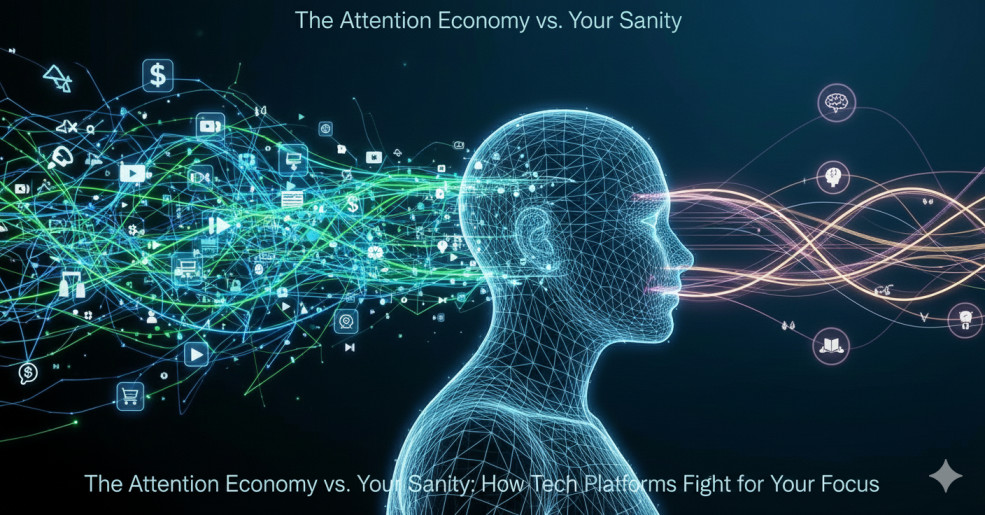
There is a war happening inside your mind every waking hour, and the opposing force has significantly more resources than you do. The platforms competing for your attention in 2026 employ psychologists, neuroscientists, machine learning engineers, and armies of A/B testers whose singular professional purpose is to ensure you spend one more second on their product than you intended. Their arsenal includes decades of behavioural research, real-time data on hundreds of millions of users, and algorithms that are optimised around the clock to discover what keeps your particular neural circuitry engaged. Your defences include willpower, awareness, and whatever friction you can introduce between yourself and the next scroll.
This is not a level fight. And understanding precisely why it isn’t — what the platforms are doing, what it does to the brain, and what the research shows about the only interventions that actually work — is the necessary prerequisite to making informed decisions about where your attention goes and who profits from it.
What the Attention Economy Actually Is
The term “attention economy” was formally developed by economists Michael Goldhaber and later Herbert Simon, who observed that as information becomes abundant, the scarcity that has economic value shifts from information itself to the human attention required to process it. Thomas Davenport and John Beck further developed this concept — arguing that in an attention economy, attention is focused mental engagement on a particular item of information, and that platforms compete for it by simultaneously exploiting both aversive attention (things you look at to avoid negative experiences) and attractive attention (things you engage with for positive reward). Short-form video platforms exploit both simultaneously: the entertaining video that pulls you in through positive engagement is followed immediately by upsetting news that grabs you through anxiety, then by a funny clip that pulls you back with relief. The alternation is not accidental. It is engineered.
Modern social media platforms utilise sophisticated algorithms designed to maximise user engagement through variable reward schedules — similar to those used in slot machines — creating dopamine loops that encourage prolonged use. The slot machine analogy has been in circulation for long enough that it risks feeling like a cliché. It shouldn’t. The analogy is precise and its precision matters. A slot machine produces intermittent reinforcement — unpredictable rewards at variable intervals — because this pattern produces stronger and more persistent engagement than predictable rewards. The “like” notification that arrives unpredictably, the comment that appears when you didn’t expect one, the viral post that emerges from an ordinary share — these are all intermittent reinforcement events, and the platforms that deliver them are optimised to maximise their behavioural effect.
The digital world runs on dopamine, converting our natural desires for reward into a cycle of endless scrolling — with experts now describing the system as the “dopamine economy,” where our engagement is the product being sold, and applications using unpredictable rewards such as likes and new videos to keep users hooked in a process that mirrors the mechanism of gambling. The commercial logic underneath this is straightforward: every second of your attention generates data, and data generates advertising revenue. Research by the Center for Humane Technology shows that people feel worse the longer they spend engaging with their favourite apps — 60 minutes of Facebook a day makes you unhappy, whereas 40 minutes makes you happy — yet the platform’s incentive structure is designed to push you toward the hour rather than stopping at the 40 minutes that serves you better. Your wellbeing and the platform’s commercial interest are not aligned, and the platform has more tools to pursue its interest than you have to protect yours.
What This Is Doing to the Brain
The neurological research on attention economy platforms has moved significantly in the last three years, and the findings are more serious than the “phones are distracting” narrative suggests. Neurological studies show that social media engagement alters dopamine pathways in ways analogous to substance addiction — with the prefrontal cortex, responsible for executive function and decision-making, showing decreased activity in heavy users, while the amygdala, the brain’s emotional response centre, becomes hyperactive. The prefrontal cortex and amygdala pattern is the one that should give pause, because what it describes is a brain that has been trained to react emotionally and impulsively while simultaneously degrading the executive capacity that would normally moderate those reactions. This is not a metaphor. It is a measurable change in how the brain allocates resources across different regions — and it reverses only with sustained reduction in the stimulus patterns that produced it.
The British Journal of Psychiatry published research in February 2026 titled “Algorithmic dopamine economies: emerging psychiatric challenges in an AI-mediated attention ecology” — identifying algorithmic attention capture as a distinct psychiatric challenge requiring public health responses, with particular urgency for adolescents whose prefrontal cortexes are still developing and whose capacity for impulse control is diminished by the same design patterns that affect adults more moderately. The word “emerging” in that title understates the pace of the problem. The research is catching up to a crisis that has been building for more than a decade — and the AI-mediated dimension is the new and accelerating factor. The AI that curates your feed in 2026 is significantly more effective at holding your attention than the algorithm that existed five years ago, because it has had five more years of human behavioural data to learn from.
A 2025 study found that blocking mobile internet on smartphones improved sustained attention by the equivalent of reversing 10 years of age-related cognitive decline — a result similar to a quarter of the difference between healthy adults and those with ADHD. Read that finding slowly, because its magnitude is striking. The measurable cognitive improvement from simply removing internet access from a phone — not meditation, not medication, not years of cognitive training — equivalent to reversing a decade of natural brain ageing. The implication is that a significant portion of what we experience as cognitive decline is actually cognitive suppression produced by chronic exposure to attention-capturing technology, and that the suppression is partially reversible when the stimulus is removed.
The attention span data reinforces this. Research shows the average human attention span has decreased from 12 seconds in 2000 to approximately 8 seconds today — a decline that has coincided precisely with the proliferation of smartphone and social media use, suggesting a causal rather than merely correlational relationship. Four seconds of sustained attention capacity lost in 25 years. The ability to hold focus on a single thing for sustained periods — the prerequisite for reading, for deep work, for meaningful conversation, for the kind of thinking that produces insight — has been eroded by exactly the platforms that claim to be keeping us better connected. The connection is real. The cost of it is the depth that would otherwise be available for everything else.
This connects directly to the broader cognitive exhaustion that our companion analysis describes — the depletion of the same prefrontal cortex resources that the attention economy attacks is also the mechanism behind the AI-driven cognitive overload documented in knowledge worker populations. Our piece on how technology platforms and AI tools are contributing to exhaustion at work addresses the professional context of the same neurological dynamic playing out in the personal sphere here.
The Business Model That Makes This Structural, Not Incidental
The most important thing to understand about the attention economy is that what it does to your brain is not a side effect. It is the product. The platforms are not incidentally addictive — they are deliberately engineered to produce the behaviours that addiction researchers recognise and that platform engineers describe, internally, as success metrics. Social media platforms employ sophisticated algorithms and design features that capitalise on basic psychological principles to maintain user engagement — including suggestions, auto-play, pull-to-refresh, infinite scrolling, and social investment mechanisms — with dopamine-scrolling now identified by public health researchers as a distinct behavioural pattern that warrants specific attention from policymakers. Each of those design features — auto-play, infinite scroll, pull-to-refresh — was engineered to eliminate the natural pause points at which a user might decide they’ve had enough. The pause point between episodes, the bottom of the page, the effort of a physical refresh — these are the friction moments where the user’s agency might reassert itself, and the platforms have systematically removed them.
The legal landscape is beginning to respond, though slowly and with significant constitutional complexity. There is increasing pressure for platforms to open their “black box” algorithms to independent researchers, with the resolution of the legal disputes over attention economy practices likely to define the boundaries of the digital age — balancing the convenience of connectivity against the imperative of psychological stability. The “black box” phrase is the crux. Regulators cannot create targeted interventions for algorithmic harms they cannot see, and platforms have resisted transparency at every stage of the regulatory conversation. The data rights framework that governs what companies can do with your personal information — explored in our analysis of the data rights economy and how consumer information flows through commercial platforms — is increasingly being applied to the attentional data that platforms collect, but the regulatory consensus is not yet formed.
The insurance dimension connects here in a way that most people don’t anticipate. The mental health consequences of chronic attention economy exposure — anxiety, depression, sleep disruption, reduced executive function — are the same conditions that mental health insurance is increasingly being asked to cover and increasingly failing to cover adequately. Our investigation into the state of mental health insurance coverage, parity failures, and access gaps in 2026 maps the healthcare system’s response to a demand that platforms are partly responsible for generating. The platforms profit from the engagement. The health consequences flow to individuals and to the healthcare system that serves them. The cost is not borne by those generating it.
The AI dimension of the attention economy deserves specific treatment, because the 2026 iteration of attention capture is qualitatively different from what existed three years ago. The algorithm curating your feed is now a large language model that understands context, sentiment, and emotional valence at a level that earlier recommendation systems couldn’t approach. It knows, with growing precision, which combination of content types, posting cadences, and notification patterns maximises your engagement — not just on average across millions of users, but for your specific profile and history. The paradox is crushing: the more these systems optimise for capturing attention, the less attention individuals have to give — because the attention itself is being degraded by the very systems consuming it. This is the closed loop that makes the attention economy genuinely insidious: it is consuming the cognitive resource it depends on.
Our piece on how AI Overviews and automation are affecting consumer visibility into financial and insurance decisions examines how the same AI systems that manage your social media feed are also influencing your access to accurate information on consequential financial matters — with the same opacity and with fewer protections for the individuals at the receiving end of the system.
What Actually Works Against the Attention Economy
The interventions with evidence behind them are not complex, but they require genuine commitment because they work against the environmental defaults that the platforms have established in your devices and habits.
A groundbreaking 2025 study in Nature Neuroscience demonstrated that specific focus exercises can increase grey matter density in the anterior cingulate cortex — the brain region critical for attention control — in just eight weeks, confirming that sustained attention is neurologically trainable and that the cognitive effects of attention economy exposure are not irreversible. Eight weeks. The same timeframe that produces measurable neurological improvement also represents roughly the period required for a new habit to achieve automaticity — which suggests that the recovery work and the habit formation work are happening in parallel, each supporting the other.
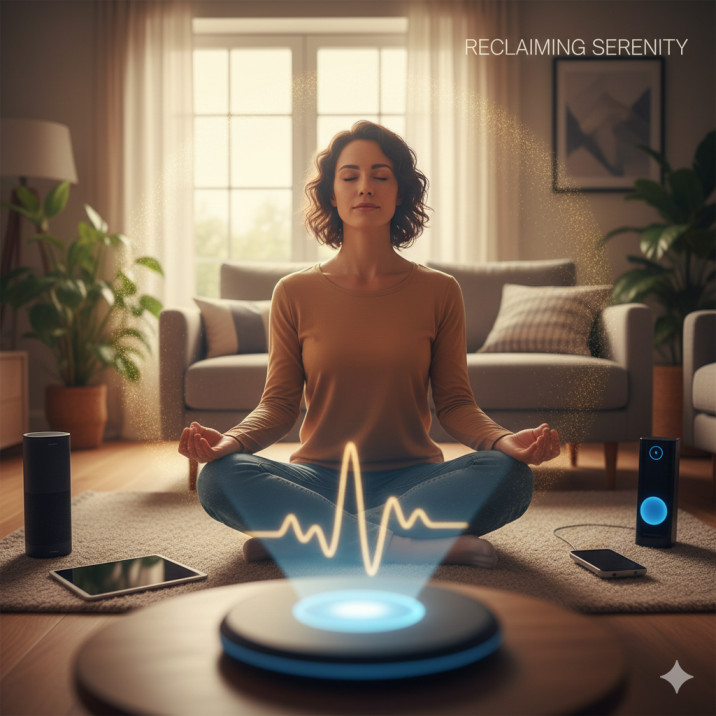
The specific practises with the strongest research support follow the same principles our analysis of digital serenity explores in the smart home context. Our piece on how to reclaim serenity when smart devices hum incessantly covers the spatial and temporal boundary interventions — screen-free zones, device-free periods, deliberate digital minimalism — that address the ambient layer of the attention economy. The attention economy practises build on those foundations with specific additions:
Notification elimination — not management, elimination — for all non-essential applications. The notification is the platform’s primary mechanism for pulling you back when you’ve left. Every notification you permit is an interruption the platform is authorised to make to your attention at the moment of the platform’s choosing rather than yours. Grayscale mode on smartphones, which removes the colour rewards that the UI design uses to make the interface more compelling, has documented efficacy in reducing compulsive checking. And the phone-in-another-room intervention is not metaphorical — the mere presence of a smartphone on a desk, even face down and silenced, measurably reduces the cognitive capacity available for the task in front of you, because part of your attention is maintaining awareness of it.
The security dimension of connected device management — explored in our analysis of how IoT devices and smart home gadgets create security vulnerabilities — overlaps with the attention economy response in one important way: the same audit of which devices you genuinely need and which merely add attentional overhead applies to both cybersecurity hardening and attention protection. The device that has no security justification also, frequently, has no attention justification. Reducing the number of platforms you actively maintain, the number of apps you allow to send notifications, and the number of devices you keep near you during recovery periods are all interventions with evidence behind them — and they compound when applied together.
Frequently Asked Questions
What is the attention economy and how do tech platforms exploit it?
The attention economy is an economic model in which human attention — not money or physical resources — is the primary scarce commodity being traded. Tech platforms exploit it by engineering their products to capture and hold your attention for as long as possible, because each second of attention generates data that generates advertising revenue. The mechanisms they use include variable reward schedules — unpredictable notifications, likes, and new content that create dopamine responses similar to slot machine gambling; infinite scrolling and auto-play that eliminate natural stopping points; and AI-driven content curation that learns, over millions of data points, exactly which content combinations keep your specific profile engaged longest. The result is that using these platforms generates revenue for the platform while consuming the cognitive resource — focused attention — that you need for everything else in your life.
What does the attention economy actually do to the brain?
The neurological effects of chronic attention economy exposure are documented in peer-reviewed research and are more serious than casual observation suggests. Heavy social media use is associated with decreased activity in the prefrontal cortex — the region governing executive function, impulse control, and complex decision-making — while the amygdala, the emotional response centre, becomes hyperactive. The British Journal of Psychiatry published research in February 2026 identifying algorithmic attention capture as a distinct psychiatric challenge, with social media engagement altering dopamine pathways in ways analogous to substance addiction. A 2025 study found that blocking mobile internet improved sustained attention by the equivalent of reversing 10 years of age-related cognitive decline. Average human attention span has declined from 12 seconds in 2000 to approximately 8 seconds in 2026, a period that coincides precisely with smartphone and social media proliferation.
Why can’t I just use willpower to stop scrolling?
The platforms are specifically engineered to defeat willpower as a defence. Variable reward schedules — the same mechanism used in slot machines — produce stronger and more persistent behavioural engagement than predictable rewards, because the unpredictability is what sustains the dopamine-seeking behaviour. The brain’s reward system becomes habituated to the rhythm of engagement and actively generates the impulse to check in the absence of a conscious decision to do so. Additionally, the prefrontal cortex — the brain region most responsible for impulse control and deliberate decision-making — shows decreased activity in heavy users, meaning the very resource you would use to exercise willpower is the one most degraded by chronic platform use. Research by the Center for Humane Technology found that people consistently feel worse the longer they use these platforms, yet continue using them — a pattern that reflects the gap between what the brain’s reward system drives and what conscious preference would choose.
Are there regulations that protect people from attention economy manipulation?
The legal landscape is evolving but has not yet produced comprehensive protections. In the United States, multiple states have enacted legislation restricting social media access for minors, and there is increasing regulatory pressure for platforms to disclose how their algorithms curate content and make that disclosure available to independent researchers. The EU’s Digital Services Act requires large platforms to conduct algorithmic audits and provide transparency about their recommendation systems. Public health researchers and psychiatrists have begun formally classifying dopamine-scrolling as a distinct behavioural pattern warranting policy responses — with the British Journal of Psychiatry’s February 2026 paper on algorithmic dopamine economies specifically calling for public health interventions. The constitutional complexity in the US, where platform algorithm design has been argued to constitute protected speech, means that regulatory progress is slower than the public health urgency warrants.
What interventions actually work against attention economy capture?
The interventions with the strongest research support are structural rather than motivational — they change the environment rather than relying on willpower. Eliminating non-essential notifications completely (not silencing them, deleting the permission) removes the platform’s primary mechanism for interrupting your attention. Keeping your smartphone physically out of reach during focused work is documented to improve cognitive performance, because the mere visible presence of a phone reduces available attention even when not in use. Blocking mobile internet access for defined periods has been shown to improve sustained attention by the equivalent of reversing 10 years of cognitive ageing in a 2025 study. Using grayscale display mode removes colour-based UI rewards. A 2025 Nature Neuroscience study found that specific focus exercises — sustained attention practices performed daily — can increase grey matter density in the brain’s attention control region in eight weeks, confirming that the cognitive damage from attention economy exposure is neurologically reversible with consistent practice.
The Bottom Line
Teaching our children to read was the educational imperative of the twentieth century. Teaching them to manage their attention may be the imperative of the twenty-first. That framing is right, but it understates the urgency of the adult version of the same problem. The attention economy is not primarily targeting children. It is targeting every person with a smartphone — and the tools available to adults are not meaningfully better than the impulse control available to adolescents when the design patterns are sophisticated enough, the AI is personalised enough, and the cognitive resource being exploited has already been degraded by chronic prior use.
The sanity you’re protecting when you limit platform access, eliminate notifications, and audit your relationship with devices is not abstract mental wellness. It is the cognitive capacity that makes everything else in your life possible — the ability to focus on one thing long enough to understand it, to be present with the people you care about, to make decisions that reflect your considered preferences rather than your conditioned impulses. That capacity is being systematically extracted for commercial profit by systems that are significantly better at their job than most people’s defences are at resisting them.
Understanding the system is the first step. It doesn’t change the fight. But knowing what you’re actually defending — and who you’re defending it against — at least clarifies what’s at stake.