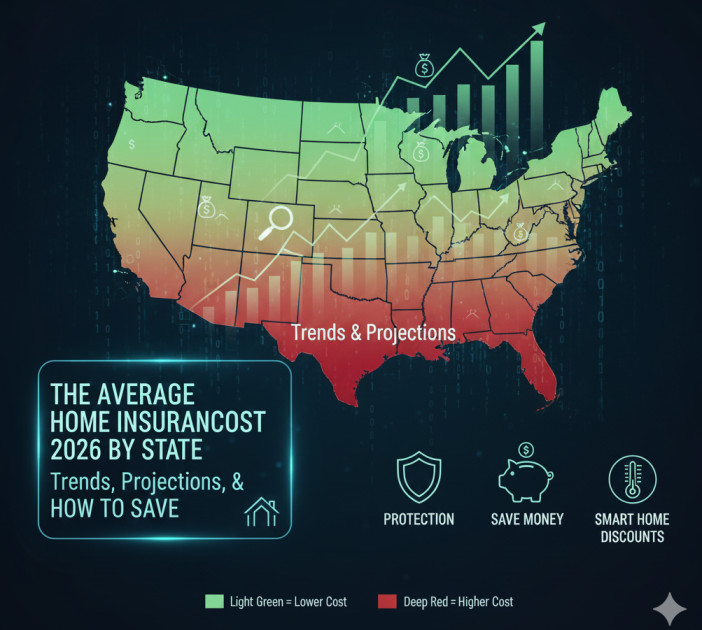
Something unusual happened in the home insurance market in 2026, and it’s genuinely worth understanding before you assume the premium trajectory you’ve experienced in recent years will continue unchanged. Homeowners insurance costs are on track to rise only about 4% nationally in 2026 — a sharp slowdown from 2025’s 12% jump and even sharper increases in 2023 and 2024 — marking what many industry analysts are calling a turning point in the most sustained period of homeowners insurance rate escalation in modern history. The moderation is real, it’s driven by measurable structural factors, and it is not evenly distributed across states. Some homeowners will see genuine relief in 2026. Others, particularly in California, Georgia, Nebraska, and Oklahoma, face double-digit increases that continue the trajectory of the last several years.
Getting the full picture — national trends, state-by-state projections, and the savings levers that actually work — requires understanding why the market moved the way it did, what changed, and why some states are still moving in the wrong direction even as the national average stabilises.
The Numbers: Where the National Average Sits in Mid-2026
The most useful benchmark for 2026 homeowners insurance is Insurify’s March 2026 projection, which draws on the most comprehensive policy dataset available and provides end-of-year projections rather than backward-looking averages. Insurify projects the average home insurance cost will reach $3,345 by the end of 2026, up from $3,129 in 2025 — representing a 36% increase over the past three years, which is approximately three times the pace of general inflation over the same period. Openly’s mid-year analysis corroborates a similar trajectory, projecting the average annual premium reaches approximately $3,057 by end of 2026, up roughly 46% since 2021.
*Eliminating homeowners insurance would save the average household $281 per month — but that option would expose homeowners to significant financial risk that far exceeds the premium savings in any scenario involving a major loss event*. The framing is useful precisely because it calibrates the magnitude of the problem: insurance now represents a material portion of the monthly cost of homeownership, approaching or exceeding property taxes in some high-risk states, and its trajectory over the last three years has made it a significant driver of housing affordability discussions that were previously dominated entirely by mortgage rates.
The average U.S. home insurance premium increased 24% between 2021 and 2024, outpacing inflation by 11% over the same period, according to the Consumer Federation of America — a figure that means homeowners have absorbed a real-terms increase in insurance cost that compounds with rising property taxes, maintenance costs, and in many markets, mortgage payments that reflected interest rate increases. Eighty-two percent of homeowners expect their premiums to rise in 2026. The expectation is so widespread it has begun shaping housing market behaviour itself: nearly half of homeowners — 49% — say they are considering a move in 2026 because of climate-related concerns, with most potential moves local rather than long-distance.
Why the Slowdown Is Happening — and Why It’s Uneven
Understanding what changed in 2025 and 2026 to slow the rate of premium increase explains why the slowdown is real but fragile, and why it hasn’t arrived uniformly.
The primary structural driver of the 2021–2025 run-up was reinsurance cost escalation. The main driver of premium increases over this period is not simply claims inflation but a doubling of reinsurance prices between 2018 and 2023 — reinsurance cost increases are passed through directly to household premiums, making this a structural shift in the cost of owning a home rather than a temporary pricing spike. Reinsurance is the coverage that insurers buy to protect themselves against catastrophic losses. When global reinsurance capacity tightened following several consecutive years of major US weather losses, primary insurers had to pay significantly more for that protection — and they passed the cost to policyholders.
That structural pressure has partially reversed. Risk-adjusted property-catastrophe reinsurance rates fell again at the June 1, 2026 renewals, down roughly 10 to 25% depending on the programme, extending a softening trend that began in 2024 — and AM Best revised its US homeowners outlook from “Negative” to “Stable”. The 2025 hurricane season helped: it was the first hurricane season in a decade without a major US landfall, allowing insurer loss reserves to rebuild and reinsurance pricing to moderate. Swiss Re projected premium growth to slow by 3%, and the combination of a benign 2025 catastrophe season and falling reinsurance costs has stabilised the market in ways that were not expected as recently as early 2025.
However, the peril that drove the most losses in the years preceding 2026 was not hurricanes. Severe convective storms in the Midwest and Southeast emerged as the top peril in 2025, surpassing hurricanes and coastal flooding in immediate risk — by September 2025, these storms had already caused $42 billion in insured losses, and 87% of insurance executives report significant or moderate concern about future losses from severe convective storms. Tornadoes, hail, and derechos don’t generate the headline coverage of named hurricanes, but their aggregate losses have exceeded hurricane losses in recent underwriting years — and the states most exposed to them are experiencing rate trajectories that bear no relationship to the national slowdown.
The National Oceanic and Atmospheric Administration’s tracking of billion-dollar weather and climate disasters provides the federal data foundation for understanding why the most affected states continue to see aggressive rate increases even as national averages moderate — the NOAA data shows not only the cost of individual events but the accelerating frequency of events that cross the billion-dollar threshold, which determines which states’ insured populations are absorbing the highest loss loads.
The State-by-State Projection: Who Gets Relief and Who Doesn’t
The 4% national average increase masks a distribution that varies from declines in some states to double-digit increases in others. The divergence reflects the geography of climate risk more than any other variable.
California is projected to experience the steepest increase of any state in 2026. Insurify projects California premiums will rise about 16% in 2026, the largest estimated hike in any state, with double-digit jumps also likely in Georgia, New Mexico, and Nebraska. California’s situation reflects both ongoing wildfire risk — which never fully resolved — and the legacy of major carrier exits from the California market that reduced competition and concentrated risk in fewer providers. Georgia’s increase reflects the expansion of severe convective storm risk into the Southeast. Nebraska’s increase reflects persistent hail exposure from Great Plains storm patterns.
Oklahoma is projected to finish 2026 as the second most expensive state for homeowners insurance, surpassing Louisiana — a ranking that reflects the dramatic escalation of severe storm losses in the Plains states. Arkansas, which previously averaged 37 tornadoes per year but recorded 107 in the past two years, is one of six states where home insurance costs make up more than 20% of the typical monthly housing payment. In response, Arkansas established the Strengthen Arkansas Homes Program, providing state-funded grants for home hardening — a model several other states have adopted to reduce premium pressure through risk reduction rather than waiting for insurers to moderate pricing organically.
Florida’s trajectory is one of the more complex stories in the 2026 data. After premiums jumped 18% in 2025 to nearly $8,300 annually following Hurricanes Helene and Milton, Florida Citizens Property Insurance — the state-backed insurer of last resort — announced an average rate decrease of 9% for 2026, with the projected average end-of-year rate reaching $5,205, reflecting both the improved reinsurance environment and the transfer of many former Citizens policyholders to private insurers. The Florida improvement is real but still leaves the state with the highest or second-highest average premium depending on methodology, and the private market remains significantly constrained compared to pre-Irma availability.
At the other end of the distribution, Hawaii, Massachusetts, Maine, Louisiana, and Rhode Island are projected to see flat premiums or slight decreases in 2026 — a consequence of the combination of stable catastrophe loss experience, improving reinsurance conditions, and competitive private markets in states without the concentrated peril exposure that drives the highest rates.
Our companion analysis of the average home insurance cost by state with a full 50-state risk breakdown provides the current rate benchmarks for all 50 states. The AI-driven underwriting models that process those state risk factors into individual premiums are examined in our piece on how AI underwriting algorithms set your insurance premiums. And the discrimination dimensions of those models — including how credit score and ZIP code can amplify premium differences beyond what climate risk alone explains — are documented in our analysis of AI bias in insurance.
How to Actually Save: The Strategies With Documented Results
The savings strategies that insurance advisors repeat most often — bundle, increase your deductible, shop around — are genuinely effective. The documentation behind them is more specific than most coverage suggests, and some strategies are more impactful than others depending on your situation.
Credit score improvement carries the most underappreciated savings potential. Research covering 70 million policies found that buyers in the bottom credit quintile pay 24% more for identical coverage on the same property in the same location as buyers in the top quintile — a 24% penalty that translates to roughly $337 more per year at 2024 average premium levels, and it compounds with every other cost driver. The Federal Housing Finance Agency’s data confirms that credit score is among the most consistent correlates of insurance premium across states where its use is permitted. The mathematical implication: improving your credit from fair to good before your next renewal can save more than most other single actions. States that prohibit credit-based insurance scoring — California, Massachusetts, and Maryland — are exceptions where this lever doesn’t apply.
Annual shopping rather than auto-renewal is the strategy with the highest average return for the least effort. Homeowners who compare quotes annually rather than allowing auto-renewal save significantly more than those who only shop when they receive a renewal notice with a large increase — the insurers competing for new business offer meaningfully different rates than the ones retaining existing customers through inertia. Online comparison tools have made this process substantially faster than the agent-by-agent calling that previously made annual shopping impractical for most households.
Premium-locking programmes are an emerging product worth knowing about. More insurers are offering premium-locking programmes that guarantee consistent premiums over three years for a small fee — in an era when premiums have risen 36% in the past three years, that type of stability is in high demand. For homeowners in states with continued rate volatility — California, Oklahoma, Nebraska — a small upfront cost to guarantee three years of stable premium may produce net savings compared to three years of market-rate renewals.
Home hardening has the longest payback period but creates the most durable premium reduction. Installing impact-resistant roofing, storm shutters, surge-protected electrical systems, and documented fire-resistant landscaping qualifies for premium discounts from most carriers in high-risk states — and qualifies for state grant programmes in an expanding number of jurisdictions. FEMA’s Building Science resources identify specific mitigation actions that reduce insurance claims frequency and severity, providing the technical basis for the discount structures that insurers offer for hardened homes. The National Flood Insurance Programme is a separate and important reminder: standard homeowners policies exclude flood damage, and FEMA’s NFIP provides the supplemental coverage that matters in flood zones, at separate pricing that is not reflected in any standard homeowners premium comparison.
Frequently Asked Questions
Insurify’s March 2026 projection — the most comprehensive analysis available, covering millions of policies — projects the average annual home insurance premium will reach $3,345 by the end of 2026, up from $3,129 in 2025. Openly’s mid-year 2026 analysis projects approximately $3,057 for the year. The difference between these figures reflects different coverage level assumptions and methodologies rather than factual disagreement. Both confirm the national average is up approximately 36 to 46% since 2021, roughly three times the rate of general consumer price inflation over the same period. The 2026 increase of approximately 4% nationally marks a significant deceleration from 2025’s 12% jump, driven by improving reinsurance conditions and a relatively benign 2025 hurricane season. The national average masks significant state-level variation, from projected annual premiums below $1,500 in the least expensive states to over $5,000 in Florida and approaching comparable figures in Oklahoma.
Insurify’s 2026 state-by-state projection identifies California as the state with the largest projected increase at approximately 16% — the result of persistent wildfire risk, major carrier market exits that reduced competition, and a premium base that was already elevated. Georgia, New Mexico, and Nebraska are projected to see double-digit increases driven by severe convective storm exposure — tornadoes, hail, and derechos — which surpassed hurricanes as the top insurance peril in 2025 based on aggregate insured losses. Oklahoma is projected to finish 2026 as the second most expensive state for homeowners insurance, surpassing Louisiana. Arkansas, which recorded 107 tornadoes in two years compared to its historical average of 37, continues to face significant increases. At the other end, Hawaii, Massachusetts, Maine, Louisiana, and Rhode Island are projected to see flat premiums or slight decreases as a benign catastrophe environment and softening reinsurance conditions provide modest relief.
The 2026 moderation in national premium growth — from 12% in 2025 to an expected 4% — reflects genuine structural improvement, primarily the softening of global reinsurance rates (down 10 to 25% at June 1, 2026 renewals) and a benign 2025 hurricane season. But the underlying risk drivers remain in place and continue pushing premiums in high-exposure states. Severe convective storms — tornadoes, hail, and derechos in the Midwest and Southeast — caused $42 billion in insured losses by September 2025, becoming the dominant insurance peril in the US market. Rebuild and labour costs remain elevated relative to 2020 levels. Wildfire risk in California and the Mountain West is not diminishing. And the repricing of catastrophe risk in global capital markets — described by academic researchers as the primary long-term driver of premium increases — is a structural shift rather than a temporary pricing cycle. The national average is stabilising; specific high-risk states are not.
The strategies with the strongest documented evidence of premium reduction are: improving your credit score — research covering 70 million policies found that homeowners in the bottom credit quintile pay 24% more than those in the top quintile for identical coverage, a gap of roughly $337 per year at average premium levels; shopping across multiple insurers annually rather than auto-renewing, since insurers competing for new business offer materially different rates than those retaining existing customers through inertia; increasing your deductible from $1,000 to $2,500 or $5,000, which typically reduces premiums 10 to 20%; bundling home and auto insurance with the same carrier; and investing in home hardening — impact-resistant roofing, storm shutters, and fire-resistant improvements that qualify for premium credits, particularly in high-risk states. Premium-locking programmes that guarantee rate stability for three years at a small upfront cost are also worth investigating in states with continued rate volatility. State mitigation grant programmes, including Arkansas’s Strengthen Arkansas Homes Program and similar models in other states, provide funding for home hardening that reduces long-term insurance costs.
In specific high-risk markets, the affordability concern is genuine. Arkansas is one of six states where home insurance costs make up more than 20% of the typical monthly housing payment, a threshold that most housing economists treat as a marker of unaffordability. In the top 5% of climate-exposed ZIP codes — primarily coastal Florida, coastal Texas, and wildfire-prone California — premiums run $722 per year above adjacent lower-risk ZIP codes for equivalent dwelling values, according to research covering 70 million policies. When private insurers exit markets or price coverage beyond homeowner reach, state-backed insurers of last resort — including Florida Citizens Property Insurance and California FAIR Plan — provide backstop coverage, typically at higher cost and with more limited coverage than the private market. Going without homeowners insurance is legally permissible if you own your home free and clear, but it exposes you to complete financial loss in a major covered event, and most mortgage lenders require it as a loan condition. If affordability is a genuine constraint, consult your state insurance commissioner’s office for information about available programmes — most states have consumer assistance resources specifically for homeowners struggling with insurance affordability.
The Bottom Line
The 2026 home insurance story is more nuanced than the “rates keep rising” narrative that dominated 2023 and 2024. The market has genuinely stabilised at the national level, driven by improving reinsurance conditions and a relatively calm catastrophe season. Homeowners nationwide are looking for predictability, not surprises, when it comes to their insurance costs — and the market’s shift from drastic annual increases toward more measured growth provides a window to lock in rates, improve your risk profile, and make the property-level investments that generate durable savings rather than one-time discounts.
That window is real but not permanent. The underlying risk drivers — climate volatility, rising rebuild costs, reinsurance market sensitivity to a single major catastrophe season — remain in place. The 2026 moderation is an opportunity, not a resolution.
This article is for informational purposes only and does not constitute insurance, financial, or legal advice. Premium projections are estimates based on available analysis as of mid-2026 and may differ from individual quotes. Always verify current rates with a licensed insurance professional.