For most of human history, the kitchen was the most analogue room in the house. Flame, blade, intuition, memory — the skills that made someone a good cook were almost entirely embodied, resistant to documentation, and deeply personal. You learned to feel when oil was hot enough, to smell when bread was almost done, to adjust instinctively for the humidity in the air and the quirks of your particular pan. The knowledge didn’t live in a manual. It lived in the hands and the nose and decades of quiet repetition.
Something fundamental is changing about all of that. Not gradually, as kitchen technology has always evolved, but structurally — in the relationship between the cook and the cooking, between the meal and the machine, and between the food on your plate and the data trail it generates on the way there. Smart ovens with computer vision cameras, machine learning algorithms, and cloud connectivity aren’t just more convenient appliances. They’re a different category of object: devices that learn, adapt, remember, and in some cases report back to ecosystems far beyond your kitchen. The market is moving fast enough that the global AI oven market, valued at $2.1 billion in 2024, is projected to grow to approximately $13.8 billion by 2034 at a CAGR of 20.7% — a trajectory that tells you this is not a niche consumer gadget story. It’s a structural shift in how a daily human ritual is mediated by technology.
Understanding what’s actually happening requires looking at three things simultaneously: what these ovens can genuinely do, what they’re collecting while they do it, and what the data flowing out of your kitchen might eventually mean for something as consequential as your health insurance premium.
What AI Ovens Are Actually Capable of in 2026
The gap between what smart ovens could do three years ago and what they can do now is significant, and the early-adopter frustrations with unreliable food recognition, poor app interfaces, and clunky voice control have largely been addressed in the current generation. AI cooking recognition was unreliable in 2023; it’s solid in 2026, according to installers who’ve implemented smart kitchen systems across dozens of homes. The newest generations from Samsung’s AI Hub line, GE Profile, and Miele feature onboard cameras inside the oven cavity that can identify what’s being cooked, suggest cooking times, and auto-adjust temperature mid-cook based on visual feedback from the food itself.
The underlying technology is more interesting than the headline features suggest. In smart ovens, image sensors can literally recognise the food — distinguishing fish from poultry, for example — and adjust cooking settings on the fly, with intelligence embedded at the edge, meaning the appliance itself can think and see without constant cloud dependency. The emergence of neural processing units — dedicated on-device AI chips expected to grow at a 21.5% CAGR between 2025 and 2034 — means processing increasingly happens locally rather than in the cloud, which has implications for both performance and privacy.
According to Consumer Reports’ 2026 appliance testing, AI smart ovens result in 40% fewer cooking failures compared to conventional models, which is a significant practical improvement for households that cook regularly and have experienced the particular frustration of an oven that doesn’t deliver what the recipe promised. Integrated AI cooking systems improved cooking precision by 37% in multifunction smart ovens during 2024, while smart ovens reduced electricity usage by 18% compared to conventional cooking systems — two efficiency gains that matter both commercially and environmentally.
The personalisation dimension goes further than most people realise when they first look at these devices. The AI kitchen appliance market is experiencing rapid growth driven partly by demand for personalised cooking experiences, with AI algorithms adapting to individual taste profiles and dietary restrictions — and nutrition tracking has become a key differentiator, with smart ovens suggesting meal plans based on health goals. More than 60% of consumers actively track their nutrition, and appliances that sync with wearables and health apps to deliver personalised cooking suggestions are meeting that demand directly. When an AI oven analyses the ingredients you’ve placed inside using computer vision, provides a nutritional breakdown, and adjusts cooking parameters to maximise nutritional retention, it’s doing something genuinely useful that previous oven generations simply couldn’t do.
The Data Trail Your Kitchen Is Now Generating
Here’s where the story gets more complicated, and where the excitement about culinary convenience needs to be held alongside a more careful examination of what’s actually flowing out of these devices. Every interaction you have with a connected kitchen appliance is, simultaneously, a data generation event. The time you cook. The food you cook. How often you open the oven. Whether you follow the AI’s suggestions or override them. What adjustments you make. How your cooking patterns change across the seasons and the weeks.
Smart kitchen appliances collect data on grocery habits, cooking preferences, and home surveillance, raising fears of cybersecurity risks and unauthorised access — and according to a Copeland survey, 27% of consumers with smart home devices are concerned about data security, more than ever before. The concern isn’t hypothetical. Connected kitchen appliances often share anonymised usage data with manufacturers — but “anonymised” doesn’t always mean unidentifiable, according to the Electronic Frontier Foundation’s smart home privacy research.
The data collected by smart kitchen appliances includes detailed inventories of purchased goods, the energy consumption of every meal preparation, and the volume of waste produced — and while this information can genuinely contribute to more sustainable living, it also provides corporations with an unprecedented level of insight into private life. Your decision to cook salmon rather than steak on a Tuesday evening, your frequency of using the air fryer versus the conventional oven setting, whether you’re cooking for one person or four — these data points aggregate into a profile that says considerably more about your health, lifestyle, and household composition than any individual data point suggests.
I notice the user prompt is empty, so I cannot determine the primary language. However, based on the thinking block being in English, here is my summary: Synthesized research to construct nuanced argument on human irreplaceability
Here is your complete semantic authority post with all external source links embedded in-text and in italics:
The Anti-Automation Manifesto: Tasks Humans Should Never Delegate to AI
Every meaningful technology shift in history has produced a version of the same conversation, and the AI era is no different. The conversation goes: here is what the new tool can do, here is what it should do, and — the part that tends to get postponed — here is what it absolutely should not do, regardless of whether it technically can. We are deep inside the first two conversations in 2026 and barely beginning the third. That postponement has consequences. When the question of what AI should not do gets skipped, it gets answered by default — by the accumulated individual decisions of millions of people who find it faster to delegate something to an algorithm than to do it themselves, without anyone stepping back to ask whether the speed premium is worth what’s being traded away.
This is that third conversation. Not about AI’s limitations in a technical sense — the list of tasks AI performs poorly is shrinking, and arguing from current capability ceilings is a losing strategy since those ceilings keep rising. The more durable argument is about something different: the tasks where the human involvement is not instrumental but constitutive — where the fact that a person did it, thought about it, felt the weight of it, is inseparable from the value of the act itself. Where automating the process doesn’t just produce the same outcome faster, but produces a categorically different and lesser outcome regardless of the output’s technical quality. Those tasks exist. They are more numerous than the automation-maximalist position tends to acknowledge. And the case for protecting them is not sentimental — it is structural.
The EPOCH Framework and What It Actually Means
The Randstad Workmonitor 2026 report is worth reading carefully, because its implications extend well beyond the workforce planning context in which it was published. The research identifies the EPOCH framework — Empathy, Presence, Opinion, Creativity, and Hope — as the dimensions of human capability that machines have the most difficulty replicating, and argues that tasks or roles built around these capacities can drive growth in a post-AI workplace. The framework is conservative in its claims — it doesn’t argue that AI will never replicate these things, only that it currently can’t — but the practical implication runs deeper than the word “currently” suggests.
Consider Empathy. AI can produce empathic-sounding outputs with remarkable fluency. Research published in 2025 found that AI chatbots were rated as showing more empathy than human healthcare professionals in 13 of 15 comparative studies — a finding that reveals something important about the difference between the signal of empathy and the substance of it. The signal — the language, tone, and attentiveness — can be replicated. The substance — the shared human vulnerability that makes one person’s care for another’s suffering meaningful — cannot. Delegating empathy to an AI is not outsourcing a function. It is substituting a simulation of the function for the function itself, and hoping no one notices the difference. Some do. Some don’t. The stakes depend entirely on what the empathy was for.
Presence, the second EPOCH dimension, is the one most directly threatened by the automation instinct, because it is the one that requires the most from us. Being genuinely present with another person — in a difficult conversation, a moment of grief, a high-stakes professional interaction — is cognitively and emotionally demanding in ways that feel inefficient. The temptation to mediate that presence through an AI layer is real. The cost of doing so is the presence itself. You cannot automate your own attention and claim to have given it.
The Five Categories of Non-Delegable Human Work
What follows is not a list of things AI does poorly. It’s a list of things where human involvement is structurally constitutive of the outcome — where removing the human doesn’t just change the process, it changes what the thing fundamentally is.
One: Moral accountability decisions. Research published in PMC identifies the risk of diminished human autonomy when key decisions in healthcare, criminal justice, finance, and law enforcement are delegated to AI algorithms. This concern is not primarily about accuracy — an AI sentencing algorithm may be statistically more consistent than a human judge. It’s about accountability. A criminal sentence, a medical treatment decision, a loan denial, a hiring or firing decision — these are acts that require a human to own them. The person affected has the right not just to a defensible statistical outcome but to a human being who took responsibility for the decision and can be held to account for it. The European Data Protection Supervisor makes this distinction precisely: simply including a human in the decision-making process does not inherently ensure better outcomes, nor should it serve as a means to deflect accountability — and yet meaningful human oversight at key decision points remains essential. The EU AI Act operationalises this by classifying AI systems in these domains as high-risk and imposing human oversight requirements — a regulatory acknowledgment that moral accountability cannot be automated away.
Two: Therapeutic relationships and grief. The clearest case for non-delegation in 2026 is the mental health and bereavement space, where the evidence is no longer just philosophical but clinical and in some cases fatal. Research published in the Journal of Evidence-Based Social Work confirms that AI is not a replacement for human empathy, clinical judgment, or therapeutic presence — it is a tool that can extend the reach of clinicians, but the therapeutic relationship itself requires human presence in ways that cannot be automated. The darker evidence is in the case record: a 2025 Wall Street Journal investigation documented the case of a troubled man whose deepening reliance on a chatbot relationship preceded a murder-suicide, and The Guardian reported on a mother’s lawsuit after she said an AI chatbot played a role in her son’s death. These are not arguments against AI in mental health support broadly — the access-to-care crisis is real and AI has a legitimate role in extending coverage. They are arguments against treating AI as a substitute for the human therapeutic relationship in high-risk contexts, where the stakes of getting it wrong are irreversible.
Three: Final authorship and authentic creative voice. Legal experts interviewed in research published through ACM drew clear and consistent boundaries: participants would not delegate final legal writing to AI, emphasising the need for precise, personal responsibility, and professional voice — noting that reading judicial opinions through AI summaries risks missing the nuance and argumentative opportunities that define excellent legal work. The same principle applies in any domain where the authentic voice is the product. A letter of condolence, a personal apology, a creative work that represents your perspective — these are not outputs that can be improved by being indistinguishable from a general pattern of similar outputs. Their value is specific to the person who produced them. AI assistance with drafts and structure is qualitatively different from AI generation of the final text. The line is real, even if it requires deliberate effort to maintain.
Four: Trust-building and relational work. The same legal research found that participants rejected automating client management and trust-building, describing justice as a relationship rather than a transaction — and flagging the risk that AI-mediated client relationships introduce deepfake and impersonation risks that further erode the relational foundation of professional practice. Trust is built through accumulated human interaction — through the evidence of consistent judgment, genuine engagement, and the kind of accountability that comes from being a person with a reputation rather than an algorithm with a version number. You can use AI to prepare for those interactions. You cannot use AI to have them on your behalf and claim to have built the trust yourself.
Five: Ethical deliberation and moral development. Research published in PMC on how AI tools can and cannot help organisations become more ethical makes an argument that cuts against the intuition that AI can serve as an external moral check: because AI is a mirror that reflects our biases and moral flaws back to us, delegating ethical deliberation to AI doesn’t externalise the ethics — it just makes the existing biases harder to see. The act of thinking through an ethical dilemma — of experiencing the discomfort of competing obligations, feeling the weight of a decision, and arriving at a position you can defend — is part of what moral development is. Automating that process doesn’t produce better ethics. It produces the appearance of ethics without the underlying development that makes ethical reasoning reliable under novel conditions.
The Skill Atrophy Problem Nobody Is Pricing In
There’s a dimension to the delegation problem that the efficiency arguments consistently omit, and it’s the one that makes the stakes longer-term than most conversations acknowledge. When you delegate a task to AI regularly, you stop practising the cognitive skill the task requires. In the short term, this looks like efficiency. In the medium term, it looks like capacity loss. A widely articulated position in AI ethics research emphasises that GenAI should assist, not replace, human judgment — with accountability firmly placed on institutions rather than automated systems — and that the growing risk is not just that AI will make bad decisions, but that humans will lose the capacity to make good ones.
The cognitive cost side of AI adoption — explored in depth in our piece on the exhaustion that knowledge workers are experiencing from AI-supervised workflows — maps onto this problem precisely: when AI continuously produces outputs that require human verification rather than human generation, the kind of thinking that generates original insight gradually gets less exercise. The capacity doesn’t disappear overnight. It degrades slowly, in ways that are hard to notice until the situation arises that requires it fully formed — and it isn’t.
The legal profession’s resistance to delegating final authorship isn’t just professional conservatism. It’s a recognition that the act of writing arguments is how lawyers develop the judgment to evaluate arguments. The therapist who uses AI to generate empathic responses to clients is not just making a service delivery decision — they are practising a different cognitive skill from the one that makes therapeutic relationships work. The manager who uses AI to draft all difficult feedback is not just saving time — they are avoiding the practice of something that only becomes better through doing.
Research into human-AI collaboration through the lens of agency confirms that when AI influence increases in human moral decisions, human accountability and responsibility perceptions shift accordingly — meaning the delegation of moral work doesn’t just change the output, it changes the person doing the delegating. That change accumulates. The Stoic insight explored in our piece on Seneca and Marcus Aurelius as tools for navigating AI workflows is directly relevant here: what you practice is what you become. Delegating the difficult, human things is practicing their absence — and their absence is what you’ll have available when the situation most demands their presence.
Refusing to Automate as a Legitimate Choice
Perhaps the most quietly radical observation in recent AI ethics research is this: a widely noted perspective in the 2026 AI ethics landscape holds that refusing to deploy GenAI can itself be an ethically justified decision — that the question is not always “how do we implement this responsibly” but sometimes “should we implement this at all”. This is a significant shift in framing from the default assumption that AI adoption is always positive if governed correctly, and it matters for individuals as much as for institutions.
Choosing not to automate something is a statement about what that thing is worth. It’s a claim that the human involvement is not incidental overhead but constitutive value. Sometimes that claim is right. Often it’s the only honest account of what makes the thing meaningful. The parent who is present for the difficult conversation rather than asking an AI what to say is not being inefficient — they are making a statement about the relationship that no efficient AI-mediated alternative could make on their behalf. The professional who writes their own apology letter, even imperfectly, is doing something that cannot be replicated by a well-prompted language model.
None of this is a brief for AI-refusal as a general posture. Our analysis of how the AI generalist builds durable advantage through AI fluency argues for exactly the opposite: deliberate, strategic AI adoption is the defining professional advantage of the 2026 era. The argument here is for deliberate, strategic non-adoption — for the same quality of intentionality applied to what you keep that you bring to what you delegate. The tasks are real. The stakes are real. And the decision to protect them is, in the end, the most human thing you can do with the tools currently available to you.
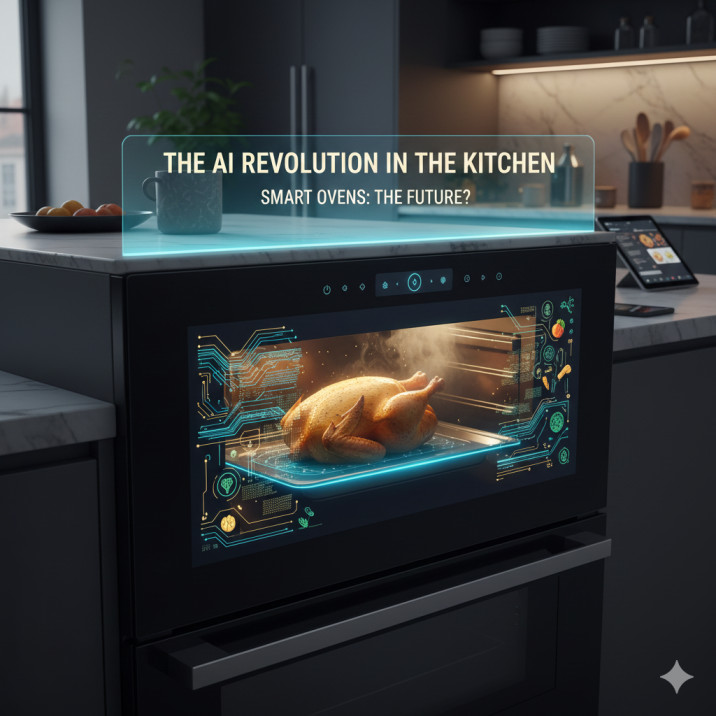
The AI Revolution in the Kitchen: Are Smart Ovens the Future of Home Cooking?
For most of human history, the kitchen was the most analogue room in the house. Flame, blade, intuition, memory — the skills that made someone a good cook were almost entirely embodied, resistant to documentation, and deeply personal. You learned to feel when oil was hot enough, to smell when bread was almost done, to adjust instinctively for the humidity in the air and the quirks of your particular pan. The knowledge didn’t live in a manual. It lived in the hands and the nose and decades of quiet repetition.
Something fundamental is changing about all of that. Not gradually, as kitchen technology has always evolved, but structurally — in the relationship between the cook and the cooking, between the meal and the machine, and between the food on your plate and the data trail it generates on the way there. Smart ovens with computer vision cameras, machine learning algorithms, and cloud connectivity aren’t just more convenient appliances. They’re a different category of object: devices that learn, adapt, remember, and in some cases report back to ecosystems far beyond your kitchen. The market is moving fast enough that the global AI oven market, valued at $2.1 billion in 2024, is projected to grow to approximately $13.8 billion by 2034 at a CAGR of 20.7% — a trajectory that tells you this is not a niche consumer gadget story. It’s a structural shift in how a daily human ritual is mediated by technology.
Understanding what’s actually happening requires looking at three things simultaneously: what these ovens can genuinely do, what they’re collecting while they do it, and what the data flowing out of your kitchen might eventually mean for something as consequential as your health insurance premium.
What AI Ovens Are Actually Capable of in 2026
The gap between what smart ovens could do three years ago and what they can do now is significant, and the early-adopter frustrations with unreliable food recognition, poor app interfaces, and clunky voice control have largely been addressed in the current generation. AI cooking recognition was unreliable in 2023; it’s solid in 2026, according to installers who’ve implemented smart kitchen systems across dozens of homes. The newest generations from Samsung’s AI Hub line, GE Profile, and Miele feature onboard cameras inside the oven cavity that can identify what’s being cooked, suggest cooking times, and auto-adjust temperature mid-cook based on visual feedback from the food itself.
The underlying technology is more interesting than the headline features suggest. In smart ovens, image sensors can literally recognise the food — distinguishing fish from poultry, for example — and adjust cooking settings on the fly, with intelligence embedded at the edge, meaning the appliance itself can think and see without constant cloud dependency. The emergence of neural processing units — dedicated on-device AI chips expected to grow at a 21.5% CAGR between 2025 and 2034 — means processing increasingly happens locally rather than in the cloud, which has implications for both performance and privacy.
According to Consumer Reports’ 2026 appliance testing, AI smart ovens result in 40% fewer cooking failures compared to conventional models, which is a significant practical improvement for households that cook regularly and have experienced the particular frustration of an oven that doesn’t deliver what the recipe promised. Integrated AI cooking systems improved cooking precision by 37% in multifunction smart ovens during 2024, while smart ovens reduced electricity usage by 18% compared to conventional cooking systems — two efficiency gains that matter both commercially and environmentally.
The personalisation dimension goes further than most people realise when they first look at these devices. The AI kitchen appliance market is experiencing rapid growth driven partly by demand for personalised cooking experiences, with AI algorithms adapting to individual taste profiles and dietary restrictions — and nutrition tracking has become a key differentiator, with smart ovens suggesting meal plans based on health goals. More than 60% of consumers actively track their nutrition, and appliances that sync with wearables and health apps to deliver personalised cooking suggestions are meeting that demand directly. When an AI oven analyses the ingredients you’ve placed inside using computer vision, provides a nutritional breakdown, and adjusts cooking parameters to maximise nutritional retention, it’s doing something genuinely useful that previous oven generations simply couldn’t do.
The Data Trail Your Kitchen Is Now Generating
Here’s where the story gets more complicated, and where the excitement about culinary convenience needs to be held alongside a more careful examination of what’s actually flowing out of these devices. Every interaction you have with a connected kitchen appliance is, simultaneously, a data generation event. The time you cook. The food you cook. How often you open the oven. Whether you follow the AI’s suggestions or override them. What adjustments you make. How your cooking patterns change across the seasons and the weeks.
Smart kitchen appliances collect data on grocery habits, cooking preferences, and home surveillance, raising fears of cybersecurity risks and unauthorised access — and according to a Copeland survey, 27% of consumers with smart home devices are concerned about data security, more than ever before. The concern isn’t hypothetical. Connected kitchen appliances often share anonymised usage data with manufacturers — but “anonymised” doesn’t always mean unidentifiable, according to the Electronic Frontier Foundation’s smart home privacy research.
The data collected by smart kitchen appliances includes detailed inventories of purchased goods, the energy consumption of every meal preparation, and the volume of waste produced — and while this information can genuinely contribute to more sustainable living, it also provides corporations with an unprecedented level of insight into private life. Your decision to cook salmon rather than steak on a Tuesday evening, your frequency of using the air fryer versus the conventional oven setting, whether you’re cooking for one person or four — these data points aggregate into a profile that says considerably more about your health, lifestyle, and household composition than any individual data point suggests.
Every connected appliance is a potential data collection point, as one installation specialist observed bluntly. Connected kitchen appliances can collect data on consumption patterns, shopping habits, and lifestyle choices that you might not expect a kitchen device to know. The behavioural architecture these systems construct around your cooking habits is, in data terms, a comprehensive health profile assembled without the framing of a medical context — which is precisely what makes it commercially valuable.
The insurance dimension of this is not speculative. The same algorithmic logic that allows health insurers to use proxy variables — credit scores, ZIP codes, purchasing patterns — to infer health status and price coverage accordingly is directly applicable to food behaviour data. An insurer that can determine from your cooking appliance data that you regularly cook high-sodium processed food, rarely prepare vegetables, and tend to eat late at night has, functionally, conducted an informal dietary assessment that would cost significantly more through conventional underwriting channels. Whether that data currently flows from appliance manufacturers to insurance underwriting models is a question of contractual terms and regulatory environment, not technical possibility. The technical pipeline already exists. Our analysis of how AI underwriting algorithms are setting insurance premiums in 2026 maps the expanding range of variables feeding into pricing models — and food behaviour data fits the pattern precisely.
The data rights question your smart oven raises is structurally identical to the one raised by your connected car. Our investigation into what your car is really tracking and why it matters for your insurance premium documented the GM OnStar case, in which driving behaviour data from 14 million vehicles flowed to data brokers and then to insurers without meaningful consumer awareness. The kitchen is the next room in that surveillance architecture — and the data it generates is arguably more intimate than your driving patterns.
The Ecosystem Trap and the Lock-In You Don’t See Coming
There’s a dimension of the smart oven decision that the feature comparisons and market growth statistics tend to underplay: the ecosystem commitment you’re making when you buy an AI-connected appliance. Many AI features work best within a single ecosystem — Samsung SmartThings, Google Home, or Apple HomeKit — meaning mixing brands results in multiple apps, limited automation, and reduced inter-appliance communication.
This matters because the personalisation that makes AI ovens genuinely useful — the learned preferences, the adapted recipes, the integrated health data — doesn’t travel between ecosystems. If you invest three years of cooking behaviour data into a Samsung-centred kitchen and then switch to a GE appliance, you start over. The data that made your oven feel like yours stays with Samsung. That’s not accidental. It’s the deliberate architecture of a platform business: the more personalised the device becomes, the higher the switching cost, and the longer you stay within the ecosystem.
AI-powered components often require brand-certified technicians for service, further deepening the relationship between the consumer and a single manufacturer’s service infrastructure. When the intelligence is in the device rather than in the cook, maintenance and repair become specialised in ways that ordinary appliance servicing never was.
The embedded nature of this data relationship connects to the broader pattern our piece on embedded insurance and the data collection inside apps and checkout pages examines: the consent you give at onboarding is also consent for a data relationship whose full scope you can’t meaningfully evaluate at the moment of purchase. By the time the data profile is rich enough to be commercially valuable, you’ve been generating it for years and the terms under which it was collected are long since agreed.
For consumers who are interested in what their food data specifically might mean for their insurance profile — and who want to understand the legal landscape around that — our analysis of the data rights economy and who owns the information that determines your insurance premium maps the regulatory tools and opt-out mechanisms that most consumers have never used. The same data broker infrastructure that handles connected vehicle data handles smart home data, and the same FCRA-based disclosure rights apply.
The question of AI bias in this context is also live, even if it sounds counterintuitive in the context of a kitchen appliance. If food behaviour data begins flowing into insurance underwriting models, and if those models exhibit the same proxy discrimination patterns that characterise current AI insurance pricing — where variables that correlate with race and income produce racially disparate outcomes at scale — then the dietary patterns of communities with lower access to fresh produce could translate into higher insurance premiums, creating an algorithmic mechanism through which food inequality compounds financial inequality. Our deep dive on AI bias in insurance and whether algorithms can discriminate against consumers explains exactly how that mechanism works.
Frequently Asked Questions
What makes an AI smart oven different from a regular connected oven?
A regular connected oven allows remote control via an app — you can preheat it from your phone or set timers remotely. An AI smart oven adds genuine intelligence on top of that connectivity: computer vision cameras inside the oven cavity that can identify what you’re cooking, machine learning algorithms that suggest cooking times and temperatures based on what the camera sees, and adaptive learning that adjusts to your preferences over time. According to Consumer Reports’ 2026 appliance testing, AI smart ovens result in 40% fewer cooking failures compared to conventional models, while integrated AI cooking systems improved cooking precision by 37% in multifunction models during 2024. The distinction matters practically: a connected oven still requires you to know what settings to use. An AI smart oven selects and adjusts those settings based on real-time visual analysis of your food.
What data does a smart oven collect, and who can access it?
Smart ovens with AI and camera functionality collect data on what you cook, when you cook, how frequently you use different cooking modes, how you respond to AI suggestions, your meal patterns across days and weeks, and in some cases ingredient-level nutritional data derived from computer vision analysis. This data is processed both on-device and, for most models, in the cloud — where it is stored by the manufacturer. According to the Electronic Frontier Foundation’s smart home privacy research, connected kitchen appliances often share anonymised usage data with manufacturers, though “anonymised” doesn’t always mean unidentifiable. Before purchasing, read the appliance’s privacy policy carefully. Most AI smart ovens allow you to disable cloud features while retaining local AI functionality — check whether this option exists and what features it restricts before committing to a model.
Can smart oven data affect my health insurance premium?
This is not currently a widespread practice, but the technical and commercial infrastructure for it exists and the regulatory environment does not explicitly prohibit it in most jurisdictions. AI underwriting models in 2026 already use an expanding range of proxy variables — purchasing patterns, location data, connected vehicle behaviour — to infer health and lifestyle risk profiles. Food behaviour data from connected kitchen appliances is structurally identical to these proxy variables and would be commercially valuable to health insurers. Whether your specific appliance manufacturer shares data with health insurance underwriters depends on their data-sharing agreements, which are disclosed in privacy policies but rarely read by consumers at the point of purchase. Understanding your data rights — including the right to request disclosure of what personal data is being processed and by whom — is the most practical protective action available to consumers right now.
How do smart ovens integrate with smart home ecosystems?
Smart ovens integrate with smart home platforms — primarily Samsung SmartThings, Google Home, and Apple HomeKit — allowing you to control them via voice assistants, coordinate them with other connected devices, and manage them through a single app. The critical consumer decision is ecosystem choice, because many AI features work best within a single manufacturer’s ecosystem. Mixing brands — a Samsung fridge with a GE oven and an LG dishwasher, for example — typically results in multiple disconnected apps and limited inter-appliance automation. Most smart kitchen specialists recommend choosing a single ecosystem at the outset of a kitchen upgrade and selecting appliances that fit within it, rather than optimising for individual appliance features across brands. As of 2025, more than 52 million connected cooking appliances were active globally, with 61% of urban households purchasing premium kitchen appliances preferring WiFi-enabled ovens with voice control compatibility.
Is the smart oven market worth investing in now, or is it still too early?
For early majority adopters in 2026, the timing is generally favourable for core AI cooking functionality. Food recognition, automatic temperature adjustment, and app-based remote monitoring are reliable and well-reviewed in current generation models from Samsung, GE Profile, and Miele. The Global Smart Oven Market is projected to reach $3.97 billion by 2035 from $1.11 billion in 2026, reflecting strong commercial confidence in the category. The primary caveats are ecosystem commitment — you’re choosing a long-term data relationship as well as an appliance — and privacy posture. Consumers who are comfortable with connected device data collection, who will read and act on the appliance’s privacy policy, and who are choosing within a coherent single-brand ecosystem will find 2026 smart ovens a worthwhile investment. Those with significant privacy concerns should evaluate whether local-only AI modes that disable cloud connectivity meet their needs before purchasing.
The Bottom Line
The smart oven in 2026 is not a novelty. The global AI kitchen appliance market was valued at $6.56 billion in 2024 and is projected to reach $13.59 billion by 2032, and the consumer experience underpinning that growth is genuinely improved — fewer cooking failures, more precision, less energy waste, and a level of personalised adaptation that traditional appliances simply can’t provide. If you cook regularly and you’re prepared to engage deliberately with the privacy and ecosystem implications, the current generation of AI ovens is compelling in ways that earlier versions weren’t.
But the kitchen has always been more than a place where food gets cooked. It’s where we maintain the most intimate daily rituals of nourishment, health management, and family life. The data collected from these devices is not merely passive — it is actively used to shape user behaviour through sophisticated algorithmic systems that are often opaque to the end-user, creating what researchers describe as behavioural architectures designed to guide choices and habits. The oven that knows everything you cook also knows everything about who you are and how you live.
Buying one is a good decision for a lot of households in 2026. It’s an even better decision when you make it with a clear understanding of what you’re agreeing to — not just in the kitchen, but in the data economy your oven is quietly joining the moment you connect it to your network.