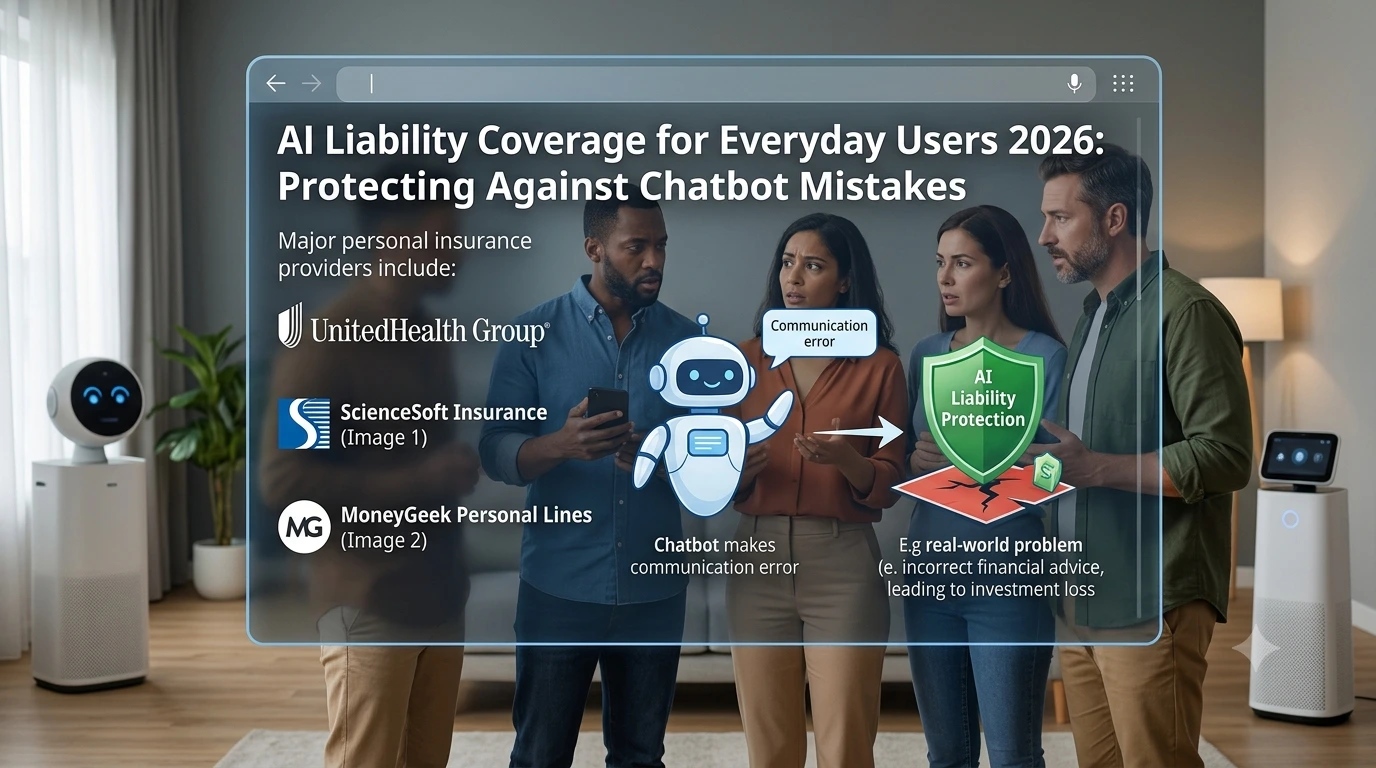
A British Columbia small claims tribunal ruling from 2024 has become the most cited legal precedent in the AI liability insurance conversation, and it’s worth starting there because it illustrates the issue more clearly than any abstract discussion of risk categories. An Air Canada passenger asked the airline’s chatbot about bereavement fares following a family death. The chatbot gave incorrect information about refund eligibility. The passenger relied on it. When Air Canada refused to honour what the chatbot said, he took the matter to tribunal – AI Liability Coverage for Everyday Users. Air Canada argued the chatbot was “a separate legal entity” responsible for its own representations. The tribunal was unimpressed. The Air Canada chatbot case established that a company is responsible for the information its AI systems provide to customers — courts and tribunals have consistently treated AI as a tool rather than an independent actor, which places the legal responsibility for AI outputs squarely on the organisation or person who deployed the system.
That ruling has rippled through the insurance market in ways that are directly relevant to anyone who uses AI in a professional capacity, operates a customer-facing AI tool, or produces AI-assisted work that others rely on. The question of what insurance covers when AI makes a consequential mistake is no longer theoretical. It’s playing out in claims departments and courtrooms, and the answers arriving in 2026 are consistently less reassuring than most AI users assumed when they started incorporating these tools into their workflows.
The Coverage Gap That Opened on January 1, 2026
For most of 2025, the question “does my insurance cover AI-related claims?” was treated as speculative by most small business owners, freelancers, and professionals who use AI tools daily. It stopped being speculative on January 1, 2026.
Verisk’s ISO division put three new endorsement forms into circulation for commercial general liability policies on January 1, 2026 — CG 40 47 01 26, CG 40 48 01 26, and CG 35 08 01 26 — each excluding coverage for losses connected to generative AI. ISO forms underpin the large majority of US property and casualty policies, so when ISO issues a new exclusion, it appears at renewal across the market rather than remaining theoretical. The three forms cover the full range of CGL coverage — bodily injury, property damage, and personal and advertising injury. The definition of “generative artificial intelligence” in these forms is broad enough to cover a customer-facing chatbot, AI writing tools used in marketing copy, and AI coding assistants that shipped bugs into sold products.
The key phrase in the exclusion language is “arising out of” — which under established insurance law requires only a causal connection to AI, not a direct cause. A claim doesn’t need to be primarily about AI to trigger the exclusion. AI simply needs to be somewhere in the chain of events. This matters practically for anyone who uses AI drafting tools in client work, operates a chatbot on a website, or uses AI to generate content that reaches third parties.
AIG, WR Berkley, and Great American have filed regulatory paperwork in 2026 to exclude AI-related claims from commercial coverage, while Berkshire Hathaway and Chubb have already received regulatory approval to do the same. The industry’s retreat from AI coverage under standard policies is not universal — some carriers are moving in the opposite direction, developing dedicated AI liability products — but the withdrawal is significant enough that professionals and small business operators need to actively verify what their current policies cover, not assume continuity from prior years’ renewal language.
What Everyday Users Are Actually Exposed To
The liability scenarios playing out in real claims and litigation aren’t limited to large companies with dedicated chatbot platforms. They’re reaching the freelance writer who uses ChatGPT to draft content a client then republishes. The attorney who uses an AI research tool that confidently cites a case that doesn’t exist. The healthcare professional whose AI-assisted screening recommendation influenced a clinical decision. The small business owner whose contact page includes a chatbot that gave a customer incorrect information about a product’s safety specifications.
AI-related lawsuits in the United States grew 978% between 2021 and 2025 according to a joint report by Gallagher Re and the Massachusetts Institute of Technology, with cumulative filings surpassing 700 cases and the year-over-year growth rate accelerating sharply in 2024 and 2025 — copyright infringement, defamation, and privacy violations driving the bulk of those cases. The growth trajectory reflects a market that is actively discovering the liability architecture of AI tools through litigation rather than through regulatory clarity that preceded deployment.
The copyright exposure category is the one that has most directly affected everyday professional users. AI image generators have been trained on copyrighted images. AI writing tools have been trained on copyrighted text. When those tools reproduce elements of protected work in their outputs, and a professional user publishes that output commercially, the question of who holds infringement liability is genuinely contested — and the user who published the content is the most reachable party for the rights holder making a claim.
The defamation exposure is equally real and similarly underappreciated. Google is being sued by Minnesota-based company Wolf River Electric after its AI Overviews feature falsely named the company as a defendant in a lawsuit, causing a customer to cancel a contract. The Google case illustrates that the harm from AI hallucination can flow to third parties who had no relationship with the AI tool — the company that was falsely named as a lawsuit defendant and lost business as a result. Anyone whose professional reputation or business identity exists in the data that AI systems draw from is potentially a subject of AI-generated misinformation, with claims consequences for the AI deployer.
The deepfake dimension extends this further. The TAKE IT DOWN Act, signed into federal law in May 2025, criminalises the non-consensual publication of AI-generated intimate images and creates civil liability for platforms that fail to remove them within 48 hours of notification — a federal law that reflects Congress’s recognition of AI-generated content as a distinct and serious harm category. The TAKE IT DOWN Act addresses a specific harm category, but the legal structure it establishes — civil liability flowing from AI-generated content that harms individuals — is part of a broader pattern of AI liability law being constructed across state legislatures and federal bodies simultaneously. The 2026 legislative landscape includes state bills specifically addressing AI companion liability, AI chatbot regulation for minors, and expanded deployer obligations — with Wiley’s analysis identifying AI companion legislation in California, Illinois, Minnesota, and New York as among the provisions most likely to create new insurable liability categories for AI users.
What Coverage Actually Exists — And What to Ask For
The insurance market’s response to the AI liability question in 2026 is divided into two trajectories: standard commercial policies moving toward exclusion, and a nascent category of dedicated AI liability products moving toward coverage. For everyday users — freelancers, small business operators, professionals who use AI in their work — navigating between these two trajectories requires asking specific questions rather than assuming either direction.
New players have entered the dedicated AI liability market in 2026. In April 2025, Armilla Insurance Services — underwritten by Lloyd’s of London syndicates including Chaucer Group — introduced an AI liability product that explicitly covers AI-specific perils. Munich Re’s aiSure product, launched in 2018 as an early mover, offers performance guarantees for AI technologies and has expanded its scope. HCP National offers a standalone generative AI third-party liability policy and an excess generative AI option for organisations with more complex needs. These products exist, they are available through commercial brokers, and their premium structure has matured enough to be applicable to businesses and professionals rather than only enterprise customers.
For professionals in high-liability fields — healthcare, legal, financial services — the question of whether AI-assisted work is covered under existing professional liability (E&O) or medical malpractice policies is specific and urgent. Pharmacists, nurses, radiologists, and physician assistants who use AI screening tools should already be asking whether their employer’s professional liability policy covers an AI-assisted error. Attorneys who use generative tools for research face sanctions and malpractice claims if a model hallucinates a case citation. These are not hypothetical future risks. They are documented current claim patterns.
The National Institute of Standards and Technology’s AI Risk Management Framework — NIST-AI-600-1 — identifies AI-generated content and automated decision support as categories of AI risk requiring documentation of human oversight, testing for accuracy and hallucination, and governance frameworks that can be demonstrated to insurers and regulators. For everyday users, the practical translation of NIST guidance is: document how you use AI tools, verify AI-generated outputs before they reach third parties, maintain records of that verification, and don’t rely on AI-generated content as an authoritative source in any professional context without review. That documentation posture is also what insurers are increasingly requiring as a condition of AI-related coverage.
The FTC has taken action against companies using AI in consumer-facing contexts that produce deceptive outputs, applying Section 5 of the FTC Act to AI-generated representations in the same way it applies to human-generated ones — which means the consumer protection framework that governs advertising, marketing, and service representations covers AI-generated versions of those same representations. The FTC’s framework matters for everyday AI users because it establishes that using AI to generate content that turns out to be deceptive doesn’t shield the user from liability — the same standard applies whether a human or an AI wrote the material.
Our earlier analysis of who pays when AI makes expensive mistakes and the liability frameworks currently governing AI decisions covers the legal accountability architecture in depth. The question of whether your existing cyber insurance covers AI-generated losses — and why the answer is increasingly no — is examined in our piece on whether cyber insurance is worth it in 2026 and what the coverage comparison looks like. And the privacy dimension of AI assistant use — including the data collection that happens on every AI platform, the settings that limit it, and the regulatory attention it’s attracting — is the subject of our guide on how to audit your AI privacy settings in 2026.
Frequently Asked Questions
Am I personally liable if an AI chatbot I use makes a mistake that harms someone?
Yes — if you deployed or operate the AI tool that caused the harm, or if you used AI-generated content professionally without adequate review and that content harmed a third party. Courts have consistently treated AI as a tool rather than an independent legal actor, placing legal responsibility on the person or organisation that deployed or used the system. The Air Canada chatbot case — in which a tribunal held the airline liable for incorrect information its chatbot gave to a passenger — is the clearest precedent: the company was held responsible for its AI’s statements. For individual professionals, the scenarios most likely to generate personal liability are: using AI research tools that produce hallucinated citations in legal or professional work; publishing AI-generated content that infringes copyright or defames a third party; or operating a customer-facing chatbot that gives incorrect advice about a product or service that a customer then relies on to their detriment.
Does standard business insurance cover AI chatbot mistakes in 2026?
Increasingly no. Beginning January 1, 2026, Verisk’s ISO division introduced three new endorsement forms — CG 40 47 01 26, CG 40 48 01 26, and CG 35 08 01 26 — that give commercial general liability carriers the option to exclude generative AI exposures entirely. These forms cover bodily injury, property damage, and personal and advertising injury arising from generative AI, and carrier adoption has been significant. AIG, WR Berkley, and Great American have all filed regulatory paperwork in 2026 to exclude AI-related claims from commercial coverage, with Berkshire Hathaway and Chubb having already received regulatory approval. The practical consequence is that businesses and professionals relying on standard CGL policies should review their renewal documents specifically for AI exclusion language rather than assuming continuity from prior coverage years. If your policy now contains generative AI exclusion language, your AI-related exposures are uncovered under that policy.
What is AI liability insurance and who offers it in 2026?
AI liability insurance is a category of purpose-built coverage designed to respond to claims arising from the use, deployment, or outputs of artificial intelligence systems — including chatbot errors, AI-generated copyright infringement, defamatory AI outputs, and AI-assisted professional errors. Dedicated products now available include: Armilla Insurance Services’ AI liability product (underwritten by Lloyd’s of London syndicates including Chaucer Group, launched April 2025), which explicitly covers AI-specific perils; Munich Re’s aiSure programme, offering performance guarantees for AI technologies; and HCP National’s standalone generative AI third-party liability policy and excess generative AI option. These products are available through commercial insurance brokers. AI-related lawsuits in the United States grew 978% between 2021 and 2025 according to a joint Gallagher Re/MIT report, and the dedicated AI liability market is developing in direct response to that litigation trajectory. Premium costs vary significantly by AI deployment type, revenue, and coverage structure — consult a commercial broker with specific AI liability experience.
What federal laws govern AI chatbot liability in the United States?
Federal AI liability law in the United States is still developing through several overlapping frameworks. The FTC applies Section 5 of the FTC Act — which prohibits unfair or deceptive acts and practices — to AI-generated content and representations in consumer contexts, meaning AI-generated marketing, advice, or service information is subject to the same deceptive practice standards as human-generated equivalents. The TAKE IT DOWN Act, signed into federal law in May 2025, specifically addresses AI-generated intimate images and creates civil liability for platforms that fail to remove them within 48 hours of notification. NIST’s AI Risk Management Framework (NIST-AI-600-1) establishes voluntary risk management guidance that increasingly informs insurance underwriting requirements. At the state level, a wave of 2026 legislation across California, Illinois, Minnesota, and New York is creating AI companion liability, chatbot disclosure requirements, and expanded deployer obligations that vary by jurisdiction. A comprehensive federal AI liability statute has not yet been enacted, meaning your specific liability exposure depends substantially on the state laws applicable to your situation.
How can I reduce my personal liability exposure when using AI tools professionally?
Five practices reduce AI liability exposure most consistently. First, verify every AI-generated output before it reaches a third party — this creates a human review layer that both limits the probability of harm and provides a defensible basis for challenging a claim that your output was AI-generated without review. Second, document your AI use and review process — NIST’s AI Risk Management Framework recommends governance documentation that can demonstrate to insurers and courts that you treated AI as a tool requiring oversight. Third, check your professional liability (E&O), general liability, and cyber insurance policies specifically for new AI exclusion language introduced at your last renewal, and ask your broker whether a dedicated AI liability endorsement or policy is available and appropriate for your use cases. Fourth, for client-facing AI tools, include clear disclosures that AI is used in your service delivery and that outputs are subject to human review — this disclosure posture reduces both liability exposure and consumer protection risk under FTC framework. Fifth, avoid relying on AI outputs as authoritative sources in professional contexts involving healthcare, legal advice, financial guidance, or safety specifications without independent expert verification.
The Bottom Line
The pattern being described by insurance professionals in 2026 is one that the market lived through before. One expert at HSB, part of Munich Re, put it plainly: “We’re seeing the same pattern we saw with cyber 15 or 20 years ago. Adoption is happening very quickly, but the understanding of how that translates into insured risk is still catching up”. When cyber risk emerged as a significant commercial exposure in the early 2000s, it spent years in a gap between the standard policies that didn’t cover it and the dedicated products that hadn’t yet arrived. The businesses that suffered most were the ones that assumed their existing coverage extended to the new risk category rather than verifying it explicitly.
AI liability is in the same gap right now. Standard policies are being rewritten to exclude it. Dedicated products are being developed to cover it. The everyday users caught between those two trajectories — the freelancers, small business operators, and professionals whose AI use creates genuine third-party exposure — are the ones most likely to discover the gap at the worst possible moment.
The action item is specific: pull your most recent renewal declarations, search for “artificial intelligence” or “generative AI” in the exclusion section, and contact your broker to clarify what’s covered. If the answer is “nothing related to AI,” the question of what dedicated coverage is appropriate for your specific use cases has an answer. In 2026, those products exist. The window to get ahead of the claims trajectory is narrowing.
This article is for informational purposes only and does not constitute insurance, legal, or financial advice. Coverage availability, exclusion language, and regulatory requirements vary significantly by state, carrier, and policy. Always consult a licensed insurance professional for guidance specific to your situation.