There are two separate moments at which a modern consumer loses meaningful visibility into their insurance decisions, and most people only know about one of them (AI overviews and Insurance). The first is the obvious one — the black-box moment when an algorithm sets your premium, denies your claim, or flags your application for reasons that aren’t explained and can’t easily be challenged. That moment has received increasing attention from regulators, researchers, and journalists, and the accountability frameworks beginning to emerge around it are the subject of genuine and necessary debate.
A 2025 analysis by Choice Mutual, reported by Kiplinger, reviewed Google’s AI Overviews for 500 life insurance queries and found errors in 57% of the responses. Choice Mutual’s CEO, Anthony Martin, said the results show AI Overviews are unreliable on complex topics like life insurance and Medicare. The study was published by the company rather than in a peer-reviewed journal, and it did not test every insurance topic, but it points to a real upstream problem: the answer a consumer reads before contacting an insurer may be wrong.
Understanding the full picture requires holding both moments together: the consumer who is misinformed by an AI search summary, then assessed by an AI underwriting model using data from sources they’ve never heard of, then potentially denied by an AI claims system — and who, at every stage of that journey, has less visibility into what’s happening than at any previous point in the history of consumer financial services.
When the Search Result Becomes the Financial Advisor
What ChatGPT, Perplexity, Gemini, and Google AI Overviews cite decides the shortlist. That observation, from Metricus’s 2026 analysis of insurance agent visibility, captures something that the traditional insurance industry has been slow to fully register: the point of consumer education has moved upstream from the agent call and the insurer website to the AI-generated search summary that answers the question before the consumer has decided where to go for help.
Salesforce’s Connected Financial Services report, based on a late-2024 survey of about 9,500 consumers worldwide, found that 54% trust AI agents in financial services but only 10% trust them completely, and 73% said it is important to know whether they are dealing with an AI agent. The survey concerned customer-service agents rather than search summaries, but the gap between partial and full trust applies here too: a reader who finds an AI summary credible, without knowing to question it, may be acting on less reliable information than they realize.
Research on how people judge AI answers points in the same direction. In a 2025 MIT Media Lab study published in NEJM AI, 300 participants rated medical answers from doctors and from an AI model. They rated AI answers that physicians had judged low-accuracy as valid, trustworthy, and complete, and many said they would follow the advice. That study concerned medical questions, not insurance, so it is an analogy rather than direct evidence. Still, it suggests that a fluent, confident AI answer can earn more trust than its accuracy deserves.
The 57% figure matters because insurance disclosure rules were largely built around the point of sale, when an insurer or agent presents a product. An AI Overview appears earlier, while a consumer is still forming expectations. One example in the study was an overview on no-exam life insurance for people over 85 that described guaranteed-issue coverage, which the study’s experts said is not offered at that age. Hypothetically, a homeowner who accepts an inaccurate summary of what a policy covers could approach an application with the wrong expectations, and an insurer’s disclosures may not fully correct them. kiplinger
This pre-sale AI influence layer connects directly to the structural analysis in our piece on the algorithmic insurance economy and how AI is reshaping risk, pricing, and consumer rights — because the consumer who enters the insurance market having been misinformed by AI is then assessed, priced, and managed by AI systems that have no mechanism for correcting the misunderstanding the search engine created. The visibility deficit accumulates across the entire journey.
The Automated Decision Layer Nobody Is Explaining
Downstream from the search experience sits the operational AI infrastructure that has, in 2026, become the primary mechanism through which insurance decisions are made. By 2026, downstream from search sits the AI that insurers use in underwriting, claims, and fraud detection. Surveys suggest most insurers now use AI in at least one function, though many remain at pilot or early-scale stages, and published estimates of how much of the claims process AI handles vary widely by method and sponsor. What matters for consumers is less any single percentage than the fact that some consequential decisions are shaped by systems that move faster than human review, which makes individual explanation harder. Those efficiency numbers are real and commercially significant. What they also describe is a substantial portion of insurance decisions — the kind that directly determine whether a consumer receives the protection they paid for — being made by systems operating faster than any human review process and at a scale that makes individual explainability structurally challenging – Insurance Business America .
The 2026 AI in Insurance Report found that 39% of consumers say it is a good idea for their insurance company to use AI to improve services, up from 20% in 2025. That growing acceptance coexists with a specific concern that the headline numbers tend to obscure. The persistent trust concern is not about AI involvement per se — it is about AI making consequential decisions without transparency or human oversight. Nearly half of consumers express distrust when AI is positioned as making claims approval, fraud detection, or policy adjustment decisions autonomously – Repairer Driven News.
The Insurity numbers describe consumers who are warming to AI as a tool but not as a decision-maker. In its February 2026 survey of more than 1,000 U.S. adults, 39% said it is a good idea for their insurer to use AI to improve services, and about one-third said they trust AI-driven insurance decisions overall. Nearly half distrusted AI making claims approval, fraud detection, or policy adjustment decisions on its own. These findings are not contradictory. They suggest people accept AI more readily as an assistant than as the final decision-maker. Insurity sells software to insurers, so treat the survey as an industry-commissioned snapshot.
Many insurance companies purchase AI tools from third parties and blame them for mistakes on policy decisions. The NAIC’s 2026 Spring National Meeting addressed this directly. At its Spring National Meeting in San Diego in March 2026, the NAIC launched a multistate pilot of its AI Systems Evaluation Tool. About 11 to 12 states are field-testing it across market conduct and financial examinations – mitchellwilliamslaw . Colorado and New York have taken different approaches, and in some states consumers are gaining rights to notice and review of automated decisions. But the direction it signals is clear, and the states moving fastest are creating what amounts to a new consumer right: the right to know when AI made a decision about you, and the right to have it reviewed by a human – U.S. News & World Report.
Colorado’s SB26-189, enacted May 14, 2026, replaces its prior high-risk AI framework with a narrower automated decision-making technology framework effective January 1, 2027, expressly including insurance-related “consequential decisions” and introducing consumer-facing obligations including the requirement to provide clear notice when automated decision-making technology is used in consequential decisions and, where an adverse decision is reached, to provide additional disclosures. New York’s Department of Financial Services has gone further, requiring clear consumer disclosures — letting applicants know AI is used in decisions and how they can challenge it. Hinshaw & Culbertson , LLP.
These are meaningful interventions. But they address only the downstream decision-making layer — the moment after the consumer has entered the system. They do nothing about the upstream AI information layer that shaped what the consumer expected before they applied. Few current rules directly address AI-generated search summaries about insurance.
The full technical anatomy of how those automated underwriting systems work — including a step-by-step hypothetical homeowner’s quote and the proxy discrimination mechanisms that can produce racially disparate outcomes without referencing race directly — is documented in our analysis of AI underwriting and how algorithms set your insurance premiums in 2026. The visibility problem isn’t just that consumers don’t know the output. It’s that they have no access to the inputs, the weighting, or the logic that connects them.
The Data Underneath Everything: The Layer Consumers Can’t See at All
There is a third layer of invisibility that sits underneath both the AI search summary and the automated underwriting decision, and it is in some respects the most consequential of the three: the data pipeline that feeds both. The consumer who searches for insurance information on Google, receives an AI Overview, visits an insurer’s website, submits an application, and is subsequently priced by an AI underwriting model has at no point in that journey been told what data was used to assess them, where it came from, or whether it was accurate.
The NAIC’s new AI evaluation framework specifically looks for data that could lead to unfair rate hikes — including the use of race or ethnicity, which is illegal to use directly, but which AI can proxy for by analysing other factors such as ZIP codes, credit scores, and more. If a Florida homeowner is denied a policy by AI, the insurer must now show that the decision wasn’t made based on biased data or secret surveillance. The framework also grants consumers the right to see and challenge the data AI uses — if an insurer’s AI uses your social media to raise your rates, the new framework allows you to review it and have it corrected – U.S. News & World Report.
Those rights sound substantial. In practice, they depend on the consumer knowing the rights exist, knowing how to exercise them, and having access to the documentation needed to make a meaningful challenge. The LexisNexis C.L.U.E. report — which records up to seven years of your auto and home insurance claims and feeding directly into underwriting decisions — is legally available to every consumer once per year. The data was always there. The visibility wasn’t. Our deep investigation into the data rights economy and who owns the information that determines your insurance premium maps the full pipeline from data collection to underwriting decision, including the specific opt-out mechanisms most consumers have never used.
Social media is among the least understood possible data inputs. Regulators are asking about it: Colorado’s life insurance AI regulation covers nontraditional external data, including social media posts, and the NAIC’s evaluation tool directs examiners to look at insurers’ data sources. That regulators ask the question shows concern, not how common the practice is. Consumers who want to know what data an insurer used can ask in writing, and request any consumer reports that contributed to a decision. insurancenewsnet
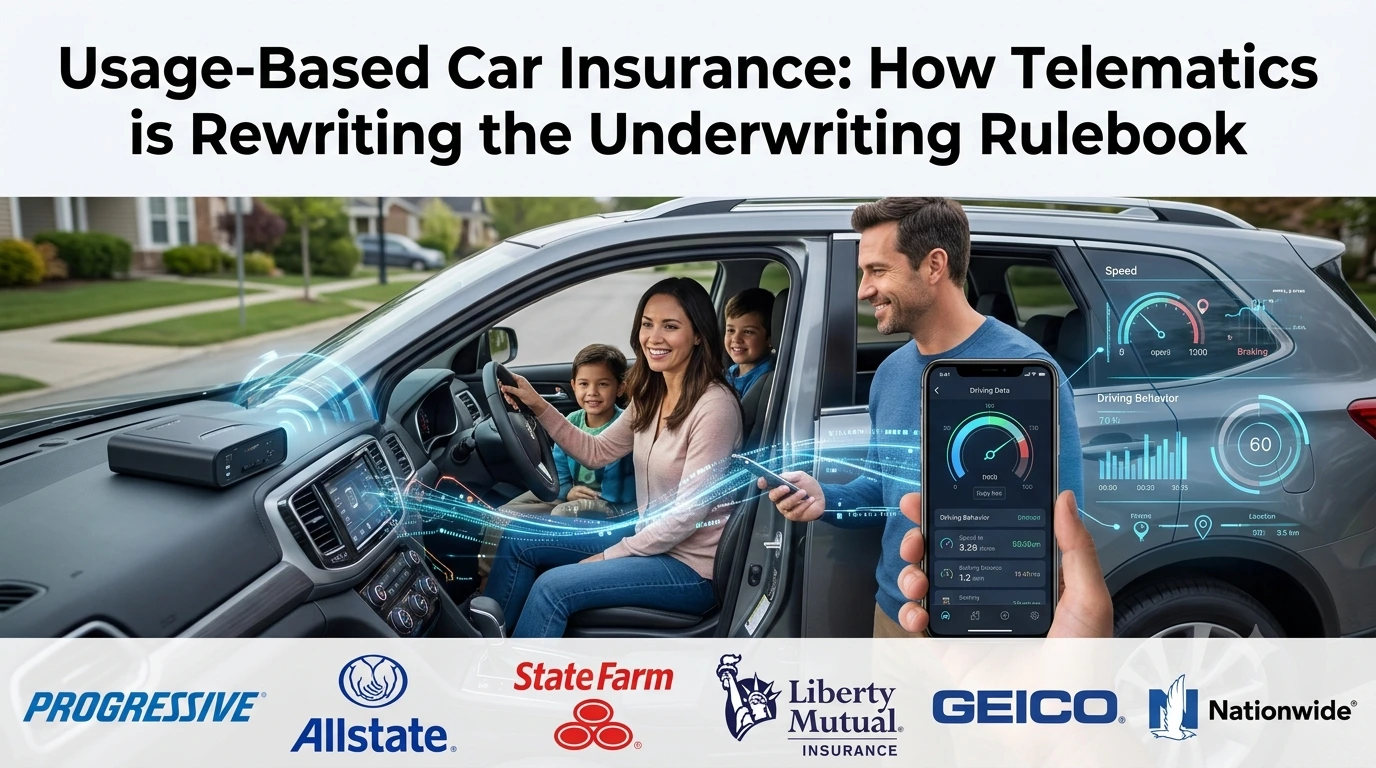
The connected vehicle dimension of this — where telematics data flows from your car to data brokers and then to insurers as documented in the GM OnStar case — represents the most extensively documented example of the invisible data pipeline. Our analysis of telematics insurance privacy risks and what your car is really tracking covers the FTC settlement and what it revealed about how location and driving data moves from consumer devices to insurance underwriting decisions without meaningful disclosure at any stage. The pattern is consistent whether the data source is a connected car, a wearable device, a social media platform, or a purchase history database: the consumer is the subject of data collection they didn’t knowingly authorise, which feeds a model they cannot inspect, producing a price or decision that arrives without explanation.
The discrimination implications of that pipeline are documented in our companion piece on AI bias in insurance and whether algorithms can discriminate against consumers, where proxy discrimination — the mechanism through which AI produces racially disparate outcomes using facially neutral variables — is explained in full. The visibility problem and the discrimination problem are the same problem: when consumers cannot see the data, the model, or the decision logic, they cannot detect or challenge the discriminatory outcomes those elements may be producing.
Frequently Asked Questions
How accurate is Google AI Overview for insurance questions?
It depends on the topic, and the evidence so far is limited. A 2025 analysis by Choice Mutual, reported by Kiplinger, reviewed Google AI Overviews for 500 life insurance queries and 500 Medicare queries, with experts checking each answer. It found errors in 57% of the life insurance responses, while the Medicare responses were accurate more often. The analysis was published on the company’s own website rather than in a peer-reviewed journal, and AI Overviews change over time, so the figure should not be applied to every insurance question. A separate MIT Media Lab study, which looked at medical advice rather than insurance, found that people rated low-accuracy AI answers as trustworthy, a reminder that a confident tone is not evidence of accuracy. Verify coverage details against your policy documents or a licensed professional.
Can I request a human review of an AI insurance decision?
There is no single national right to human review of an AI insurance decision, so it depends on where you live and the type of decision. Colorado’s SB26-189, signed May 14, 2026 and effective January 1, 2027, requires notice when automated decision-making technology is used in consequential decisions, including insurance-related ones, and adverse-decision disclosures. New York’s Department of Financial Services issued Insurance Circular Letter No. 7 in July 2024, setting out its expectations that insurers disclose their use of AI systems and external consumer data in underwriting and pricing, and explain adverse decisions. The NAIC’s AI Systems Evaluation Tool is for regulators and does not create consumer rights. If your state has no equivalent rule, ask your insurer in writing for the specific reasons for any adverse decision. If a consumer report contributed to it, the Fair Credit Reporting Act entitles you to an adverse action notice and a copy of that report.
What data does AI use to make insurance decisions about me?
In 2026, AI underwriting models can draw on far more data than appears on an application, including your claims history via the LexisNexis C.L.U.E. report (up to seven years of auto and home claims), credit score and financial history, ZIP code and property records, connected vehicle telematics data if your car is enrolled in any programme, social media activity in some cases, and third-party data broker profiles compiled from public records and purchased datasets. The NAIC’s new evaluation framework identifies specific data inputs that may create unfair rate hikes — including ZIP code, credit score, and other proxy variables that can correlate with race or ethnicity despite not referencing those characteristics directly. You are entitled to request your LexisNexis Consumer Disclosure Report free once per year at consumer.risk.lexisnexis.com to see what claims and telematics data is on record about you.
Why do nearly half of consumers distrust AI for insurance decisions despite growing acceptance of AI generally?
Insurity’s February 2026 survey of over 1,000 consumers found that while support for AI in insurance has grown substantially — from 20% in 2025 to 39% in 2026 — nearly half of consumers express distrust specifically when AI is positioned as making claims approval, fraud detection, or policy adjustment decisions autonomously. The distinction consumers are drawing is between AI-assisted processes where humans remain accountable and AI-autonomous decisions where there is no human in the loop. Salesforce’s Connected Financial Services research confirmed that 73% of consumers want to know upfront whether they are communicating with an AI agent — meaning the consent and transparency dimensions matter as much as the accuracy question. The governance model that both regulators and commercially successful insurers have converged on in 2026 is AI processing with human accountability — not AI replacing human oversight entirely.
What should I do before relying on AI-generated insurance information?
Treat any AI-generated insurance summary — including Google AI Overviews, ChatGPT responses, and chatbot answers on insurer websites — as a starting point for inquiry rather than a definitive answer, particularly for questions about coverage terms, exclusions, claim eligibility, and policy limits. Because at least one study found errors in more than half of Google AI Overviews on life insurance, verify any specific claim against the actual policy document or with a licensed insurance professional before making a coverage decision. For consequential questions — whether a specific event is covered, whether a claim will be approved, what your legal rights are after a denial — the appropriate source is your policy’s declarations page, your state insurance commissioner’s office, or a licensed broker with fiduciary responsibility for the advice they provide. AI search summaries have no fiduciary duty to you and no regulatory accountability for inaccurate insurance guidance.
The Bottom Line
The insurance industry’s AI transformation is delivering efficiency gains that are real, measurable, and in many cases genuinely beneficial — faster claims processing, more personalised products, fraud detection at scales human teams couldn’t achieve. None of that is in dispute. What is also not in dispute, in 2026, is that the same transformation has created three distinct layers at which consumers have less visibility into the decisions affecting their financial protection than at any previous point in the industry’s history.
The governance model that works commercially in 2026 — AI processing, human accountable — is also the governance model that regulators are requiring. Alignment between commercial and compliance requirements is, for once, complete. That alignment matters enormously and should not be minimised. But it addresses only the downstream decision-making layer. It does not address the AI search environment that misinforms consumers before they apply. It does not address the data pipeline that assembles the consumer profile without the consumer’s knowledge. And it does not address the accumulated visibility deficit that results from operating across all three layers simultaneously – AI Buzz.
The consumer who understands all three layers — who treats AI search summaries as starting points, requests their consumer disclosure reports, and knows their right to challenge AI decisions — is meaningfully better protected than the consumer who doesn’t. That knowledge isn’t hard to acquire. But it has to be sought out, because the industry, the regulators, and the search engines haven’t made it automatic yet.