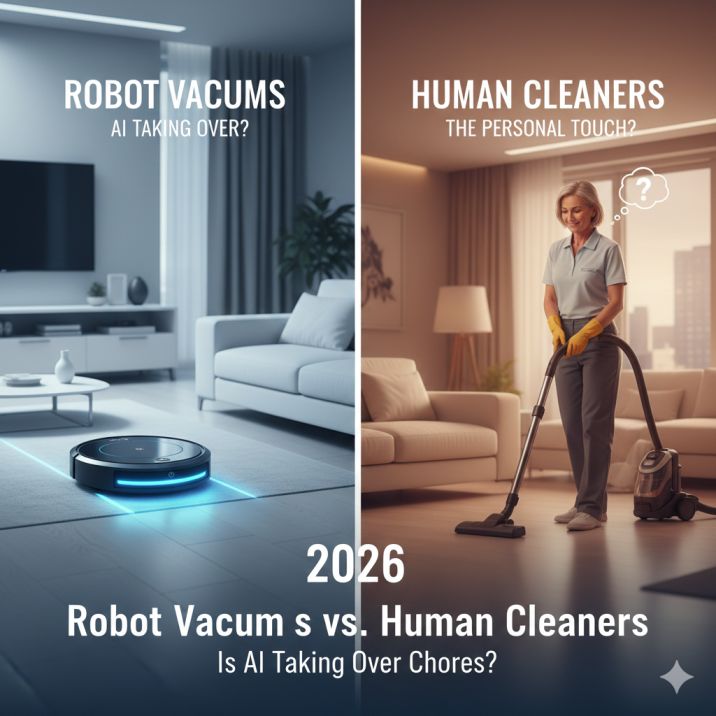
The question of who should manage home upkeep—a person or a perpetual-motion machine—is no longer one of simple novelty. In 2026, it represents a genuine, complex calculation involving advanced artificial intelligence (AI), escalating labor costs, and the ultimate pursuit of time freedom.
For years, the robot vacuum was the clumsy, bump-and-go device, useful only for light upkeep between real cleanings. Today, however, we live in the era of the AI-powered Cleaning Ecosystem. These machines map, recognize objects, self-empty, wash their own mops with hot water, and even boast conceptual features like robotic arms to reach corners.
The competition is no longer between a cheap toy and a professional. It is between a tireless, intelligent appliance that is always on the clock and a skilled human cleaner who brings judgment, dexterity, and compassion to the job.
The answer to whether AI is taking over chores in 2026 is a resounding Yes—but only certain chores. This analysis delves into the technological leaps of modern cleaning robots, provides a full cost comparison, and determines the ultimate winner of the domestic chore wars.
🤖 The 2026 Robot: An AI Revolution in Home Cleaning
The modern robot vacuum is less of a vacuum cleaner and more of a mobile, autonomous home ecosystem manager. The advancements projected for 2026 have successfully addressed nearly every major limitation of the previous generation.
Advanced AI and 3D Navigation
The clumsy navigation of the past has been supplanted by sophisticated AI mapping and obstacle avoidance.
- LiDAR, vSLAM, and 3D Edge Detection: Current high-end models use a fusion of technologies: LiDAR (laser mapping), vSLAM (visual Simultaneous Localization and Mapping), and 3D cameras. This allows the robot to construct a highly accurate, dynamic 3D map of your home.
- Object Recognition: New AI chips can differentiate between a misplaced sock, a power cord, and pet waste. The robot doesn’t just avoid the obstacle; it identifies it, logs it on the map, and adjusts its cleaning strategy, often reporting the object to the user via the app.
- The Shift to 3D Coverage: While still early-stage for the mass market, disruptive concepts (like bionic QuadTrack technology or multi-articulated bionic arms) are emerging. This shifts cleaning from a 2D floor task to a 3D room task, promising the ability to dust high ledges and finally clean baseboard corners.
The Mopping and Maintenance Breakthrough
The biggest historical weakness of the robot—its ineffective mopping and high maintenance—is now its greatest strength.
- Fully Automated Maintenance: Today’s flagship models fully automate the mopping process. They return to their docking station, where the mop pads are automatically washed with detergent and dried with hot air (often using water up to 100∘C) to prevent mildew and odor. The advanced docking stations also automatically empty debris and refill the clean water tank.
- Forceful Cleaning: Static mop pads are obsolete. They have been replaced by spinning mop pads or pressurized roller mops that apply significant downward force (up to 1.5 kg) to actually scrub, not just wipe, hard floors, making them a viable competitor to manual mopping.
In 2026, the robot is truly a “set-it-and-forget-it” device for routine, daily floor maintenance.
🧑 The Human Cleaner: Value of Judgment and Dexterity
While the robot excels at repetitive, planar tasks, the human cleaner offers irreplaceable value in tasks requiring dexterity, nuanced judgment, and complex spatial awareness.
Specialized and Vertical Cleaning
A human cleaner’s primary advantage lies in their ability to operate in three dimensions and handle delicate, non-standard tasks.
- Vertical Surfaces and Detail: Robots cannot clean windows, wipe down shower doors, scrub grout, dust intricate bookshelves, or sanitize the inside of an oven. These specialized, detail-oriented tasks are the core competence of professional cleaning services.
- Dexterity and Organization: A person can move clutter, organize items, and then clean the area. While conceptual robots with articulated arms are emerging, a robot cannot offer the complex decision-making required for tidiness and organization.
- Problem-Solving: If an antique requires a special cleaner, or if a valuable document is mixed with trash, a human cleaner applies judgment and common sense to prevent damage—a task far beyond current consumer AI.
The Human Factor
The value of a professional service extends beyond the immediate cleaning.
- Trust and Accountability: The security and accountability (especially through insured cleaning companies) of a scheduled service remain a significant psychological advantage when inviting someone into your most private space.
- Consistency vs. Maintenance: A human cleaner’s performance is consistent. A robot’s effectiveness relies entirely on the owner performing periodic maintenance (cleaning sensors, replacing filters, descaling tanks), which, if neglected, diminishes the robot’s performance.
💰 The Great Financial Calculation: Total Cost of Ownership (2026)
The financial battle in 2026 is a comparison of Total Cost of Ownership (TCO) for the robot versus the recurring cost of Professional Labor.
Robot Vacuum TCO (Premium Model)
The focus here is on the premium, fully automated models necessary to compete with human cleaning.
| Cost Component | Estimated 2026 Cost (USD) | Notes |
| Initial Purchase | $1,200–$1,800 | Flagship self-emptying, self-washing model (3-year lifespan) |
| Annual Consumables | $100–$150 | Replacement filters, brushes, proprietary cleaning solution |
| Repair/Battery Replacement | $150 (Avg. over 3-year life) | Budgeting for one major repair or battery replacement |
| 3-Year TCO | $1,650–$2,300 | Averaging $550–$767 per year |
Professional Human Cleaner Cost (Standard Bi-Weekly Service)
This average is based on a standard 1,500-2,000 sq. ft. home, cleaned bi-weekly (26 times per year).
- Hourly Rate (US/Western Markets): $30–$55 per hour
- Annual Cost (26 sessions): $2,080–$4,160
The Verdict on Cost
For basic, routine floor cleaning, the robot vacuum wins the financial battle decisively. The three-year TCO of a premium robot is roughly equal to 6 to 12 months of bi-weekly human cleaning.
Therefore, the robot is best framed as a cost-effective supplement that allows you to reduce the frequency or duration of professional human cleaning visits.
🚀 Synthesis: The Future of Home Cleaning in 2026
The competition between the robot and the human cleaner will not end with a single victor. Instead, 2026 marks the year of Hybrid Home Cleaning, where AI takes over the monotonous burden of daily upkeep, and human professionals are elevated to specialized, less-frequent service providers.
- The Robot’s Domain (Frequency and Maintenance): The robot is the indispensable primary cleaner. Its value lies in high-frequency, low-effort maintenance. By running once a day, it ensures the home remains at a consistently high baseline level of cleanliness.
- Ideal Use: Daily floor vacuuming and mopping.
- The Human’s Domain (Depth and Dexterity): The human cleaner is elevated to the role of the Deep Cleaner and Sanitizer. Their job shifts from general floor cleaning to the monthly or quarterly, intensive tasks that robots cannot touch.
- Ideal Use: Bi-monthly or monthly deep cleaning, including bathrooms, kitchens, high dusting, and organization.
In a hybrid model, a homeowner runs their premium robot daily and reduces human cleaning from bi-weekly to monthly, saving money while maintaining a superior, continuous level of cleanliness.
Conclusion: Why AI Taking Over Chores 2026 is a Win-Win
Is AI taking over chores in 2026? Yes, it is taking over the worst chores—the daily, repetitive, and time-consuming floor maintenance that once defined cleaning drudgery.
By 2026, the AI cleaning robot is no longer a luxury; it is a foundational utility for modern households. It represents a permanent reduction in the daily cognitive load of housekeeping.
However, the human cleaner remains the irreplaceable agent of specialized cleaning, organization, and problem-solving. The most efficient and clean home in 2026 is one that employs both: the tireless AI for maintenance and the skilled professional for depth and detail. This partnership is the true future of home hygiene, freeing up human time and energy for tasks the robots can’t yet comprehend.
If you are looking to see some of the cutting-edge robot vacuums that are pushing the limits of home automation, you might find this overview helpful: Best Robot Vacuums 2026 – Top 6 Best Models So Far. This video discusses the top-rated models that are defining the 2026 automated cleaning landscape.