
The annual home insurance renewal notice is a source of increasing anxiety for homeowners ubiquitously. As we previously discussed, the core issue driving rates is a “triple threat”: escalating catastrophic weather, persistent construction inflation, and a hardening global reinsurance market.
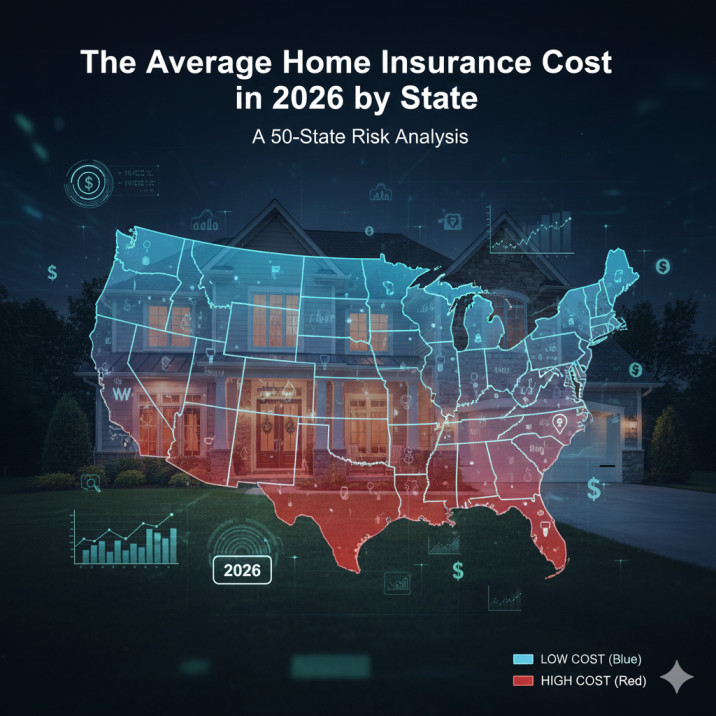
To truly understand how this impacts your wallet, we must look beyond isolated numbers and analyze the systemic risk that defines your state’s insurance market. Since definitive 2026 rates are not yet finalized by state regulators, providing 50 precise dollar amounts is both impossible and misleading.
Instead, this comprehensive analysis categorizes all 50 states into five distinct Risk Tiers. This method provides the most accurate projection of where the highest premium hikes and market volatility will occur, giving you the necessary information to prepare for your 2026 renewal.
We break down the estimated Home Insurance Cost 2026 based on state-specific climate exposure, regulatory environment, and market stability.
🌎 The 50-State Home Insurance Risk Tiers for 2026
We have grouped all 50 states into five categories, ranging from Extreme Risk (Tier 1, facing the highest rate hikes and non-renewals) to Lowest Risk (Tier 5, facing inflation-only increases).
| Risk Tier | Risk Level | Primary Cost Drivers | States Included |
| Tier 1 | Extreme Climate & Market Volatility | Coastal Hurricanes, Wildfire, Litigation, Insurance Market Exit | FL, LA, CA, MS |
| Tier 2 | High Severe Weather (SCS) Risk | Hail, Tornadoes, Wind, High-Frequency Claims | TX, OK, KS, NE, CO |
| Tier 3 | Moderate-High Coastal/Urban Risk | Northeast & Southeast Storms, High Rebuilding Costs, Flooding | NY, NJ, MA, CT, RI, DE, SC, NC, VA, MD |
| Tier 4 | Moderate Inland Risk (Inflation-Driven) | Isolated Tornadoes, Ice Storms, Material Inflation | PA, OH, MI, IL, IN, MO, WI, MN, GA, AL, AR, TN, KY, WV, AZ, NM, UT, NV, OR, WA |
| Tier 5 | Lowest Risk & Stable Market | Pure Inflation, Very Low Claims Frequency, Low CAT Exposure | WY, ID, MT, ND, SD, IA, NH, VT, ME, AK, HI |
Tier 1: Extreme Climate & Market Volatility (FL, LA, CA, MS)
- Projected 2026 Rate Hikes: 15%–30%+
- The Drivers: Hurricanes and Wildfires dominate the risk profile. In states like Florida and Louisiana, a vicious cycle of catastrophic claims, coupled with aggressive insurance litigation, has made it nearly impossible for private insurers to operate profitably.
- The 2026 Reality: Homeowners face continued non-renewals and the real possibility of being moved to state-backed insurers of last resort (e.g., Florida’s Citizens or California’s FAIR Plan). Policyholders must be vigilant, as coverage gaps and deductibles (especially wind/hurricane deductibles) are often massive. Home Insurance Cost 2026 here will be the most unpredictable and highest in the nation.
Tier 2: High Severe Weather (SCS) Risk (TX, OK, KS, NE, CO)
- Projected 2026 Rate Hikes: 10%–18%
- The Drivers: High-Frequency Claims. This region, often called “Hail Alley” and “Tornado Alley,” faces the most frequent and costly type of weather damage in the continental U.S.: Severe Convective Storms (SCS). Unlike a single annual hurricane, SCS damage occurs constantly, leading to millions of smaller, expensive claims (roof replacement, siding damage).
- The 2026 Reality: Insurers are increasingly imposing specific, percentage-based deductibles for wind and hail (e.g., 1% to 5% of the dwelling value). Average Home Insurance Premiums here are consistently high, driven not by one-off catastrophe but by the sheer volume of claims year after year. Home hardening (especially Class 4 roofing) is crucial to mitigate the Home Insurance Cost 2026.
Tier 3: Moderate-High Coastal/Urban Risk (NY, NJ, MA, CT, RI, DE, SC, NC, VA, MD)
- Projected 2026 Rate Hikes: 7%–12%
- The Drivers: High Property Value and Named Storms. This tier includes the densely populated Northeast and Mid-Atlantic coasts, where the primary risk is two-fold: coastal exposure and extreme rebuilding costs. The high cost of labor and specialized building materials in major metros means claims for even moderate damage are extraordinarily expensive.
- The 2026 Reality: Insurers are focusing heavily on flood risk (often excluded from the standard policy) and demanding high dwelling coverage limits to match rising construction costs. The Home Insurance Cost 2026 in these states will rise primarily due to inflationary pressures and the increasing severity of winter storms and coastal erosion.
Tier 4: Moderate Inland Risk (Inflation-Driven) (PA, OH, MI, IL, IN, MO, WI, MN, GA, AL, AR, TN, KY, WV, AZ, NM, UT, NV, OR, WA)
- Projected 2026 Rate Hikes: 5%–8%
- The Drivers: General Inflation and Localized Severe Weather. This large, diverse tier spans the Midwest, Southeast, and most of the Pacific Northwest and Southwest. Premiums are primarily increasing due to the high cost of rebuilding (the main driver of Average Home Insurance Premiums across this tier).
- The 2026 Reality: Insurers are stable here, but the global increase in reinsurance costs is passed directly to the consumer. Homeowners in this tier benefit the most from proactive rate shopping, as carriers are competitive and willing to offer deep discounts for bundling and low claims history. Your primary goal is to ensure your dwelling coverage is accurate—not over-inflated based on market value—to keep the Home Insurance Cost 2026 controlled.
Tier 5: Lowest Risk & Stable Market (WY, ID, MT, ND, SD, IA, NH, VT, ME, AK, HI)
- Projected 2026 Rate Hikes: 3%–6%
- The Drivers: Pure Inflation and Economic Factors. These states boast the lowest Average Home Insurance Premiums in the country due to low population density, minimal coastal exposure, and infrequent catastrophic events. The increases here are almost exclusively tied to rising labor costs, construction materials, and standard economic inflation.
- The 2026 Reality: Homeowners here enjoy the most stable market. Home Insurance Cost 2026 increases will likely track the general inflation rate. The biggest benefit is the certainty—there is very little risk of non-renewal or massive, unpredictable rate spikes.
🛠️ 5 Actionable Strategies to Lower Your 2026 Home Insurance Cost
Regardless of your state’s risk tier, you have direct control over your individual premium. Don’t wait until your renewal notice arrives—start implementing these items today.
1. Maximize Discounts and Loyalty
Ask your current agent about every possible discount:
- Bundling: Combining auto and home policies remains the most effective discount (up to 20%).
- Safety Features: Install centrally monitored alarm systems, professional smoke alarms, and water leak detectors—a huge emerging discount, especially in Tier 4.
2. Optimize Your Deductible for Risk
Raising your deductible is the most direct way to lower your premium.
- The Trade-Off: Moving your standard deductible from $1,000 to $2,500 can reduce your premium by 10% to 20%. In high-risk tiers (Tier 1 & 2), consider a separate, higher deductible for Wind/Hail events, provided you can cover the out-of-pocket expense.
3. Implement Home Hardening Against Local CAT Risk
Insurers reward proactive mitigation, particularly in Tiers 1, 2, and 3.
- Tier 2 (Hail): Install high-impact roofing materials (Class 4). This can lower your premium and reduce your deductible.
- Tier 1 (Wildfire): Create defensible space by clearing brush 100 feet around your home and ensuring your roof and siding materials are non-combustible.
4. Review Your Dwelling Coverage Annually
Inflation Guard features may be increasing your dwelling coverage (A) by too much, leading to unnecessarily high premiums.
- Verify Accuracy: Ask your agent for a formal replacement cost estimator report to ensure your coverage is based on realistic construction costs—not inflated market value.
5. Shop The Market Every Two Years
Rates across carriers can vary by 40% for the exact same coverage because each insurer uses proprietary data models that weigh risk factors differently.
- The Best Time: Start shopping 45 to 60 days before your 2026 renewal date. This gives you ample time to secure a better rate and potentially switch carriers before they automatically renew your policy at the higher rate.
Final Outlook on Home Insurance Cost 2026
The outlook for Home Insurance Cost 2026 is clear: Premiums will continue their upward trajectory, driven by forces far beyond your immediate control. The era of cheap, static home insurance premiums is over, particularly in states exposed to major climate events.
However, by understanding your state’s position within these 5 Risk Tiers, you are prepared for your 2026 renewal with knowledge and leverage. Implementing strategic home hardening and maximizing discounts can significantly offset the expected premium hike, protecting both your investment and your budget.
Don’t wait for your 2026 renewal notice to hit your mailbox. Use this risk analysis to take control of your policy today and secure the best Average Home Insurance Premiums possible.





One Comment