The annual home insurance renewal notice is one of the least pleasant pieces of mail any homeowner receives. In recent years, that notice has come with a heavy dose of sticker shock, driven by record-breaking natural disasters, soaring inflation, and a volatile global reinsurance market.
As we look ahead to 2026, the question is not if Home Insurance Cost 2026 will continue to rise, but by how much, and where will the increases hit the hardest?
A crucial note upfront: Since 2026 rates are not yet finalized by state regulators, it is impossible to provide definitive numbers. Instead, this comprehensive analysis pivots to the most critical data point: projecting 2026 costs based on current 2025 averages, major economic drivers, and state-specific climate trends.
This guide breaks down the estimated Average Home Insurance Cost in 2026 by State, identifies the three primary forces that will shape your next renewal premium, and provides actionable strategies to protect your budget.
📈 The New Reality: Why Home Insurance Rates Are Accelerating
For decades, the average annual growth in U.S. home insurance premiums hovered between 3% and 5%. That era is definitively over. The industry is currently facing a “triple threat” that makes underwriting—the process of assessing risk—more difficult and exponentially expensive.
The Triple Threat Driving 2026 Home Insurance Cost
1. Climate Change and Catastrophe Risk (CAT Events)
This is the undisputed number one driver. A single major hurricane, wildfire, or severe convective storm (SCS, covering tornadoes and hail) can cost insurers billions, depleting reserves and forcing companies to raise rates across entire regions.
- 2026 Projection: States prone to coastal risks (Florida, Louisiana, North Carolina) and Western wildfires (California, Oregon) will continue to face double-digit percentage increases. Regulators in these states are also seeing more major insurers reduce their exposure or pull out entirely, leading to fewer options and dramatically higher premiums for the remaining carriers.
2. Inflation and Rebuilding Costs
Home insurance covers the cost of rebuilding your home, not its market value. The pandemic-era supply chain disruption and subsequent inflation have permanently altered the cost of construction.
- The Component Costs: The cost of labor, lumber, concrete, roofing materials, and specialized contractors are all significantly elevated compared to five years ago. This directly pushes up the dwelling coverage limit (A) of your policy. If your $300,000 home now costs $400,000 to rebuild, your insurer must charge more for that added risk exposure.
- 2026 Projection: While general inflation may cool, construction inflation remains sticky. Insurers will continue to mandate higher dwelling coverage limits, directly translating to a higher Home Insurance Cost 2026.
3. The Reinsurance Market Hardening
Reinsurance is, effectively, insurance for insurance companies. When an insurer faces massive losses (e.g., from Hurricane Idalia), they rely on reinsurers to pay out the billions in claims.
- The Problem: Due to successive years of heavy losses globally, reinsurers are charging primary carriers significantly more to take on risk. Those added costs are immediately passed down to consumers through higher premiums.
- 2026 Projection: As long as global CAT losses remain high, the reinsurance market will remain “hard,” maintaining upward pressure on Average Home Insurance Premiums nationwide, even in states with historically low claims.
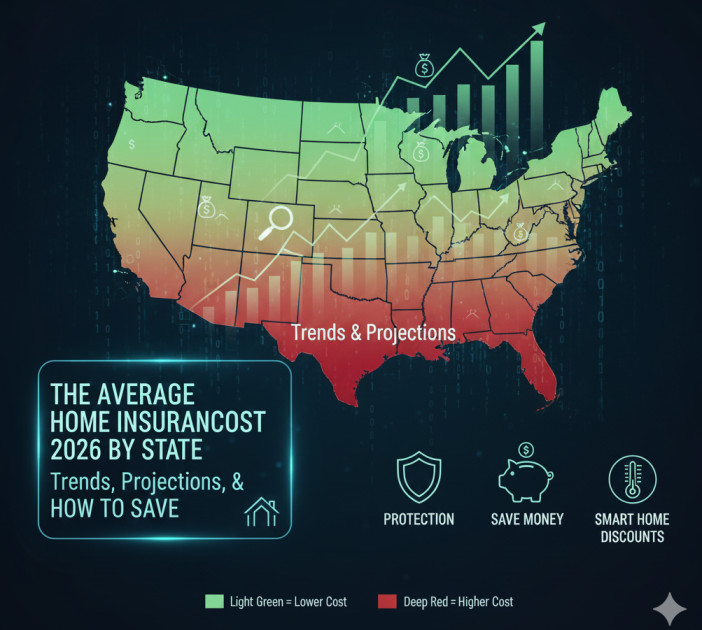
📊 Projected Average Home Insurance Cost in 2026 by State
The table below provides realistic, projected Estimated Average Annual Home Insurance Premiums for a standard HO-3 policy for a home with $250,000 in dwelling coverage. These figures are calculated by taking current 2025 market estimates and applying an inflation factor based on state-specific risk trends.
| State | Risk Profile Category | Estimated 2026 Average Premium (Annual) | Primary 2026 Cost Driver | Projected Change (2025 to 2026) |
| Florida | High-Risk Coastal/CAT | $5,500−$7,800+ | Hurricanes, Litigation Costs, Reinsurance | 15% – 25% |
| Louisiana | High-Risk Coastal/CAT | $4,000−$5,500 | Hurricanes, Wind/Hail Claims | 12% – 18% |
| Texas | High-Risk Severe Weather | $3,500−$4,800 | Hail, Wind, Tornadoes (PCS Storms) | 10% – 15% |
| California | High-Risk Wildfire | $1,900−$3,500 | Wildfire Risk, FAIR Plan Dependence | 8% – 12% |
| Colorado | Severe Weather (Hail) | $2,800−$3,900 | Hail Claims (Denver Metro), Increasing Severity | 10% – 14% |
| Kansas | High-Risk Tornado/Hail | $3,000−$4,500 | Centralized Tornado/Hail Alley Claims | 12% – 17% |
| New York | Mid-Risk (Northeast Storms) | $1,500−$2,300 | Regional Flood/Wind Risk, Construction Inflation | 6% – 10% |
| Illinois | Mid-Risk Inland | $1,600−$2,400 | Tornadoes, General Inflation | 5% – 8% |
| Washington | Low-Risk Inland/Wildfire | $1,100−$1,700 | Growing Wildfire Risk (East), Earthquake (Low) | 7% – 11% |
| Idaho | Low-Risk Inland | $800−$1,200 | General Inflation, Low Claims Frequency | 4% – 6% |
| Massachusetts | Mid-Risk Coastal | $1,400−$2,200 | Hurricane Exposure, High Rebuilding Costs | 7% – 10% |
| North Carolina | High-Risk Coastal | $2,200−$3,500 | Hurricane/Flood Risk, Population Growth | 10% – 15% |
Read more on The Average Home Insurance Cost in 2026 by State: A 50-State Risk Analysis
State Deep Dive: Understanding the Cost Categories
The table highlights that Home Insurance Cost 2026 is not uniform. Premiums follow specific risk profiles:
- Category 1: High-Risk CAT/Coastal States (FL, LA, TX, CA): Rates in these states are dictated by industry survival. Insurers are fighting to stay solvent. Homeowners here face non-renewals and may be forced into the state-sponsored “insurer of last resort” (like Florida’s Citizens), which can be cheaper initially but often offers less comprehensive coverage.
- Category 2: Severe Weather/Hail Alley (KS, CO, TX, OK): While they don’t face hurricanes, these states are the epicenter of Severe Convective Storms (SCS), which includes massive hailstones and tornadoes. This sustained, high-frequency damage keeps Average Home Insurance Premiums high and drives consistent, though perhaps less dramatic, annual rate hikes.
- Category 3: Low-Risk Inland States (ID, UT, IA): These states benefit from lower exposure to major CAT events. Their Home Insurance Cost 2026 increases will be driven almost entirely by the universal factors: construction material inflation and the rising cost of global reinsurance. Their rates may appear to jump by a smaller percentage but often remain the most affordable in the country.
🛠️ 5 Actionable Strategies to Lower Your 2026 Home Insurance Cost
Knowing the drivers of rate hikes is the first step; the next is implementing strategies to mitigate them. Don’t wait until your renewal notice arrives—start working on these items today.
1. Maximize Discounts and Loyalty
Before switching carriers, ask your current agent about every possible discount.
- Bundling: Combining your auto and home policies remains the most effective discount (up to 20%).
- Safety Features: Smart home technology (leak detectors, professional smoke alarms, smart doorbells) can earn significant safety discounts.
- Policy Loyalty: Staying with the same carrier for five or more years often qualifies you for a loyalty discount.
2. Optimize Your Deductible
A deductible is the amount you pay out-of-pocket before insurance kicks in. Raising your deductible is the most direct way to lower your premium.
- The Trade-Off: Moving your standard deductible from $1,000 to $2,500 can reduce your premium by 10% to 20%. Ensure you have the necessary cash reserves to cover the higher deductible if disaster strikes.
3. Review Your Dwelling Coverage Annually
In an inflationary environment, your dwelling coverage (A) is likely being automatically increased by your insurer to keep up with rebuilding costs.
- Verify Accuracy: While some inflation guard is necessary, check that the estimated rebuilding cost hasn’t been inflated based on your home’s market value rather than actual construction costs. Ask your agent for a cost estimator report.
4. Harden Your Home Against Specific Local Risks
In high-risk areas, insurers reward proactive measures.
- Wind/Hail: Install high-impact roofing materials (Class 4), reinforced garage doors, and hurricane shutters.
- Wildfire: Create defensible space by clearing brush 100 feet around your home and installing non-combustible roofing or siding. Many insurers now offer premium reductions or require specific mitigation efforts.
5. Shop The Market Every Two Years
Even if you love your current carrier, shopping around is the only way to ensure you are getting the best rate. Rates across carriers can vary by 40% for the exact same coverage because each insurer uses proprietary data models that weigh risk factors differently.
- The Best Time: Start shopping 45 to 60 days before your 2026 renewal date. This gives you time to compare offers and implement new safety measures.
Final Outlook on Home Insurance Cost 2026
The outlook for Home Insurance Cost 2026 is clear: Premiums will continue their upward trajectory, particularly in climate-exposed states. The era of cheap, static home insurance premiums is over.
However, the power is still in your hands. By understanding the forces driving the rates—climate, inflation, and reinsurance—you can prepare for your 2026 renewal with knowledge and leverage. Implementing strategic home hardening and maximizing discounts can offset a significant portion of the expected premium hike, protecting both your investment and your peace of mind.
Don’t wait for your 2026 renewal notice to hit your mailbox. Take control of your policy today and secure the best Average Home Insurance Premiums possible.