
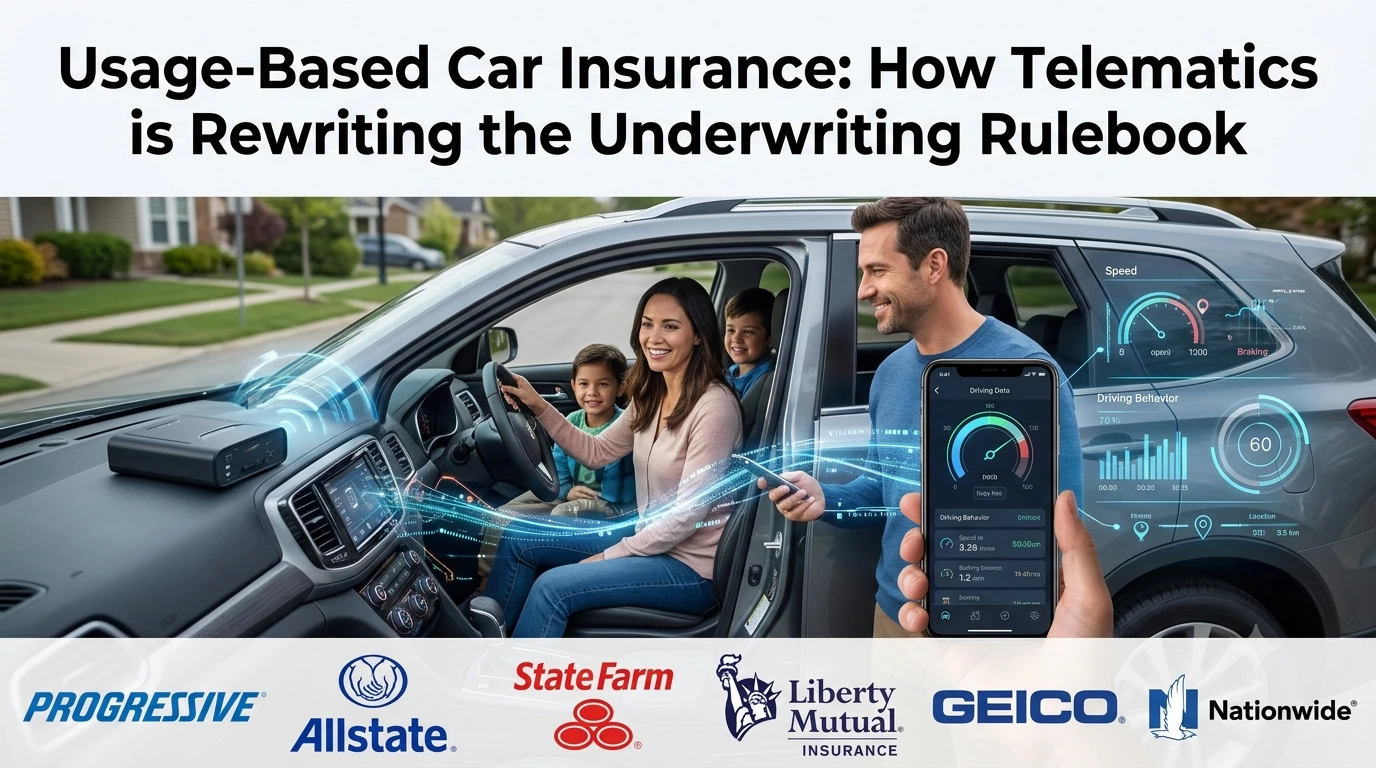
For as long as auto insurance has existed, the fundamental transaction has been an estimation. The insurer estimates your risk based on the characteristics you share — your age, your address, your claims history, the vehicle you drive — and prices a policy accordingly (Usage-based car insurance). You are charged, in essence, for what you look like on paper rather than what you actually do behind the wheel. For the majority of policyholders, this produces a premium that overpays for the risk they actually represent. For the statistical minority who drive badly and know it, the traditional model has historically been a subsidy.
Usage-based insurance changes that transaction at its root. Instead of estimating your risk from demographic and historical data, it measures your actual driving behaviour and prices you accordingly. The mechanism is telematics — technology that tracks how fast you drive, how hard you brake, how aggressively you accelerate, and when and how far you travel — and the pricing model built on that data is, in principle, the most individually accurate risk assessment the auto insurance industry has ever been able to achieve. Whether it produces premiums that are fairer, cheaper, or more surveillant than the traditional model depends enormously on where you sit in the distribution of actual drivers — and on how much of your personal driving data you’re comfortable transmitting to a commercial entity in exchange for the chance at a lower bill.
What Telematics Actually Measures
The data inputs that feed a usage-based insurance programme fall into several categories, and understanding them is the prerequisite for understanding what the resulting premium actually reflects.
The simplest category is mileage. Pay-per-mile insurance — sometimes called Pay-As-You-Drive — charges a base rate plus a variable rate per mile driven, measured directly through a tracking device. If you drive 4,000 miles a year, you pay considerably less than someone driving 16,000 miles in the same vehicle, because miles driven is the single variable most directly correlated with accident exposure. This model is straightforward, relatively transparent, and the privacy implication is modest: the insurer learns how much you drive and roughly where you go.
Pay-How-You-Drive goes further, measuring not just distance but behaviour. Usage-based auto insurance telematics collects data on mileage, speed, braking, acceleration, and time of day via OBD-II devices, smartphone apps, or embedded systems — with primary types encompassing pay-as-you-drive, pay-how-you-drive, pay-per-mile, and hybrid approaches. The behavioural variables have a strong actuarial basis: hard braking events correlate with following too closely or inattentive driving; rapid acceleration correlates with aggressive driving styles; late-night driving correlates with fatigue and elevated accident risk in population data. These correlations are real and statistically meaningful, which is why they produce more accurate risk pricing than demographic proxies.
The three primary hardware delivery systems are the OBD-II plug-in device, the smartphone app, and embedded factory telematics. OBD-II devices led the market with 34.69% revenue share in 2025, while smartphone-based systems are growing fastest at a 14.05% compound annual growth rate through 2031, because smartphone telematics eliminates installation costs and uses native gyroscopic and GPS sensors, making it accessible without any physical device. Embedded telematics — factory-installed systems that the automaker controls — represents the fastest-growing category because they remove the consumer opt-in decision almost entirely; the capability is built into the vehicle at manufacture.
The National Highway Traffic Safety Administration has published Cybersecurity Best Practices for the Safety of Modern Vehicles, addressing the security obligations of connected vehicle systems — including telematics infrastructure — and the standards that manufacturers and their data partners are expected to meet for protecting data transmitted from vehicles. The NHTSA guidance reflects federal recognition that vehicle data is not merely commercial but safety-critical, and that the infrastructure transmitting it requires security standards comparable to other critical infrastructure.
The Actuarial Logic Behind Behaviour-Based Pricing
To understand why usage-based insurance represents a genuine shift in underwriting philosophy rather than simply a marketing differentiator, it helps to understand what traditional actuarial models are doing and where they fall short.
Traditional auto insurance pricing assigns you to a risk segment defined by observable characteristics that correlate with claims frequency in historical data. Your age group, your zip code, your vehicle model, your claims history, and your credit score are all variables that predict, at a population level, how likely drivers like you are to file claims. The model works in aggregate — the correlation between these variables and claims frequency is real — but it applies group averages to individuals who may differ significantly from their statistical cohort. A 22-year-old who drives cautiously, rarely, and exclusively in daylight pays the same rate structure as a 22-year-old who drives aggressively, frequently, and after midnight, because the traditional model cannot distinguish them.
The National Association of Insurance Commissioners — NAIC — has described usage-based auto insurance as tracking driving behaviors via telematics to set premiums, with the benefit of incentivising safer driving while raising privacy concerns, and the acknowledged limitation that the NAIC notes “not everyone is a better than average driver” — some participants end up paying more than they would have under a traditional policy. That last observation from the NAIC is the honest counterweight to the “fairness” pitch that UBI marketing tends to lead with. The individualisation that UBI enables cuts in both directions. For drivers who are genuinely safer than their demographic average, UBI produces lower premiums and is experienced as fair. For drivers who are worse than their demographic average, UBI produces higher premiums and is experienced as punitive — even though it is, by the actuary’s standard, more accurate.
The scale of adoption indicates that the market believes the efficiency gains are worth the complexity. As of 2024–2026, approximately 20% of US auto insurance policies incorporate some form of telematics, up from roughly 15% in 2022 and less than 10% in 2020, representing 45–50 million active telematics policies in the United States. The growth trajectory indicates that insurers are finding the model commercially useful — lower-risk drivers are self-selecting into UBI programmes, which improves the portfolio quality of the carriers offering them.
The AI layer that has been added to telematics processing in 2026 extends the model significantly. New tools such as advanced driver monitoring, contextual risk scoring, and incident detection are now embedded in hybrid telematics systems that are improving underwriting accuracy further, with AI-powered risk engines and behavioural trend analysis combining to deliver a risk assessment capability that static historical models cannot approach. The practical consequence for policyholders is that the model assessing your risk is continuously learning — not just averaging your behaviour over a programme period, but detecting patterns and anomalies that a static scoring approach would miss. How those inferences translate into pricing decisions is not fully transparent to policyholders, which is where the regulatory conversation is increasingly focused.
How to Choose Between Pay-Per-Mile and Pay-How-You-Drive Insurance
Usage-based insurance is not one single type of policy. Two of the most common approaches are pay-per-mile and pay-how-you-drive programs. Understanding the difference can help you determine whether telematics is likely to work in your favour.
Pay-Per-Mile Insurance
Pay-per-mile insurance bases part of the premium on how much you actually drive. Depending on the insurer and program, you may pay a base amount plus a variable amount tied to your mileage.
This approach can be particularly attractive to people who drive relatively few miles, such as:
- People who work primarily from home
- Retirees who drive infrequently
- Drivers who use public transportation for part of their commute
- Households with a second vehicle that is rarely used
- People who generally keep their vehicle parked for long periods
However, low mileage does not automatically mean pay-per-mile insurance will be the cheapest option. The insurer may consider other factors when calculating the premium, and the program’s terms can vary considerably.
Pay-How-You-Drive Insurance
Pay-how-you-drive (PHYD) programs use telematics to evaluate aspects of driving behaviour. Depending on the insurer, the program may consider factors such as:
- Braking patterns
- Acceleration
- Mileage
- Speed
- Time of day
- Duration and frequency of trips
- Other driving patterns detected through the telematics device or mobile app
The exact information collected and the way it affects your premium varies by insurer and program.
A driver who consistently demonstrates behaviours that an insurer considers lower risk may potentially benefit from participating in a PHYD program. On the other hand, drivers who frequently drive at night, travel in heavy traffic, brake aggressively, or otherwise produce data that an insurer considers higher risk should carefully review the program’s scoring methodology before enrolling.
Which Type of Usage-Based Insurance Makes More Sense?
There is no universally best UBI program. The right choice depends on how much you drive, how you drive, how comfortable you are sharing driving data, and how the insurer calculates your premium.
| Driver profile | UBI option worth investigating | Why |
|---|---|---|
| Drives relatively few miles | Pay-per-mile | Mileage can have a greater role in the cost of coverage |
| Works primarily from home | Pay-per-mile | The vehicle may be used less frequently |
| Drives frequently but maintains consistently safe habits | Pay-how-you-drive | Driving behaviour may influence the premium |
| Wants driving behaviour considered when pricing insurance | Pay-how-you-drive | Telematics can provide the insurer with behavioural data |
| Does not want driving or location data collected | Traditional insurance | Avoiding telematics may provide greater data privacy |
| Frequently drives late at night | Compare program rules carefully | Some programs may consider time of day |
| Regularly drives in heavy traffic | Compare program rules carefully | Braking and acceleration patterns may be evaluated |
| Wants predictable pricing without behavioural monitoring | Traditional insurance may be preferable | The driver avoids a telematics-based pricing model |
Before You Enroll in a Telematics Program
Don’t compare UBI programs based solely on the advertised discount.
Before enrolling, ask the insurer:
- What data does the device or app collect?
- Is location data collected continuously or only during trips?
- Which driving behaviours affect the score?
- Can poor driving data increase my premium, or does the program only provide discounts?
- Can participation affect my renewal price?
- What happens if I stop participating in the program?
- How long does the insurer retain my telematics data?
- Is the data shared with third parties, contractors, affiliates, or other organizations?
- Can I access or request deletion of the data where applicable?
- What happens if the app, device, or GPS records inaccurate information?
These questions matter because the financial benefit of usage-based insurance should be evaluated alongside the privacy and contractual implications of sharing driving data.
A Lower Premium Isn’t the Only Consideration
A telematics program can make sense when the potential savings outweigh the privacy and behavioural-monitoring concerns for a particular driver. But a discount should not be the only reason to enroll.
Compare the total premium, coverage limits, deductibles, exclusions, data-collection practices, and renewal rules with a conventional policy before making a decision.
For example, a program advertising a substantial potential discount may not necessarily produce the lowest overall cost if its starting premium is higher than another insurer’s conventional policy. Likewise, a driver who places a high value on privacy may reasonably decide that a slightly higher premium is preferable to sharing detailed driving data.
The most useful comparison is therefore not simply:
“How much can I save?”
It is:
“What will I pay, what coverage will I receive, and what information will I have to share to get that price?”
Your Data, Their Decisions: The Rights You Should Know
The data governance dimension of telematics insurance is where consumer rights are most consequential and most underexplained. When you enrol in a UBI programme — whether through an OBD-II device, a smartphone app, or your connected vehicle’s native telematics — you are consenting to data collection under terms that deserve careful reading before you sign.
The Fair Credit Reporting Act governs the use of telematics data in insurance rating and policy management — sharing of driving data is subject to FCRA oversight, and insurers are required to disclose how they use driving information and how it affects your premium. Insurers need clear, informed consumer consent before collecting or using telematics data, and data should only be used for insurance rating and policy management. Those are the requirements as they exist on paper. The consent you provide through a programme enrolment agreement can, however, be considerably broader than those baseline requirements suggest.
The FTC has finalised an order settling allegations that GM and OnStar collected and sold geolocation data without consumers’ meaningful consent — a case that established that vehicle telematics data shared with third-party data brokers without adequate disclosure can constitute an unfair or deceptive practice under Section 5 of the FTC Act. The GM case is the most significant federal enforcement action on vehicle data privacy to date, and it sends a signal to insurers and automakers that telematics data sharing practices are under active FTC scrutiny. It does not mean that all telematics data sharing is prohibited — it means that sharing must be meaningfully disclosed to and consented to by the driver.
The Supreme Court’s 2018 decision in Carpenter v. United States — in which the Court held that the government requires a warrant to access historical cellphone location data because it constitutes a detailed record of physical movements — established a constitutional principle with implications for how granular telematics data is treated in legal contexts. While Carpenter specifically addressed government access rather than commercial data sharing, it reflects a broader judicial recognition that persistent location tracking produces a uniquely intimate portrait of a person’s life that deserves heightened protection.
As of 2025, roughly twenty states have enacted comprehensive consumer data privacy laws, many of which classify precise geolocation data as sensitive personal information with additional protection requirements — and some participation agreements allow the insurer to share driving data with affiliated companies or data analytics partners, with previously collected data not automatically deleted if a consumer leaves the programme. That last point is the one most people don’t think to check before enrolling: leaving a telematics programme does not necessarily erase the data already collected. Understanding the data retention terms before you enrol is not paranoia. It is basic consumer due diligence.
The deeper context of how telematics data flows through the broader insurance data ecosystem — and what rights consumers have to inspect and challenge the consumer reports built from it — is examined in our piece on the data rights economy and who controls the information that determines your insurance premium. The LexisNexis consumer disclosure report that contains your driving history data is an FCRA-protected document you can request annually and dispute for errors — a right that most UBI participants don’t know they have.
The Fairness Question the Industry Is Still Navigating
The NAIC began formally pressing for accountability on telematics data in 2025. In January 2025, consumer advocates asked the NAIC Property and Casualty Committee to provide guidance, gather telematics data, and publish a detailed report on usage-based insurance — reflecting growing regulatory concern that the expanding role of telematics in insurance pricing is outpacing the oversight frameworks designed to ensure those prices are fair and non-discriminatory. The NAIC’s comprehensive study on UBI — published as part of its insurance market regulatory series — acknowledged the efficiency benefits of telematics while raising the question that sits at the heart of the fairness debate: whether behaviour-based pricing can produce discriminatory outcomes through variables that correlate with protected characteristics, even when the variables themselves are facially neutral.
The concern is specific and documented. Night driving frequency, which correlates with accident risk, also correlates with shift work employment patterns that are unevenly distributed across racial and income lines. Sudden braking frequency, which correlates with aggressive driving, can also reflect driving in dense urban traffic conditions where hard braking is sometimes unavoidable rather than indicative of driver behaviour. The model cannot always distinguish between a driver who brakes aggressively because they drive aggressively and a driver who brakes frequently because they commute through downtown traffic. Our analysis of AI bias in insurance and whether algorithmic pricing can discriminate against consumers maps the proxy discrimination mechanism that makes this concern genuine and regulatory, not just theoretical.
The NAIC’s comprehensive study on Usage-Based Insurance and Vehicle Telematics: Insurance Market and Regulatory Implications examines how telematics changes the underwriting model, the data challenges involved, and the implications for insurers, consumers, and state regulators — establishing the foundational regulatory framework within which UBI programmes operate. For regulators and consumers alike, that study remains the primary reference document for understanding what UBI programmes are required to disclose, how state commissioners are approaching them, and what redress mechanisms exist when pricing produces outcomes that feel unfair.
The mechanism connecting telematics data to insurance pricing decisions — and what AI underwriting models do with the raw data before it becomes a premium — is explored in detail in our piece on how AI underwriting algorithms are setting insurance premiums in 2026. The short version is that the raw telematics data doesn’t directly become your premium; it passes through a scoring model that weights different behavioural signals according to their actuarial relationship with claims frequency, and those weights are proprietary. You receive a score. The scoring methodology stays with the insurer.
Frequently Asked Questions
What is usage-based insurance and how does it differ from traditional car insurance?
Usage-based insurance (UBI) prices your car insurance premium based on your actual driving behaviour rather than demographic estimates. Traditional auto insurance assigns you to a risk segment defined by characteristics such as age, zip code, vehicle model, and credit score — variables that predict claims frequency at a population level but apply group averages to individuals who may drive very differently from their statistical cohort. Usage-based insurance replaces or supplements those demographic variables with direct measurement of your driving patterns through telematics technology, tracking variables such as miles driven, speed, braking force, acceleration, and time of day. Drivers who are safer than their demographic average typically pay less under UBI than under traditional pricing. Drivers who are riskier than their demographic average typically pay more. The NAIC notes that “not everyone is a better than average driver” — some participants end up paying more than they would have under a traditional policy. As of 2026, approximately 20% of US auto insurance policies incorporate some form of telematics.
What data does a telematics insurance programme collect about my driving?
Telematics insurance programmes typically collect: miles driven and route data via GPS; speed and speed variation; braking frequency and intensity (how hard and how often you brake); acceleration patterns; time of day when driving occurs (night driving is associated with higher accident risk in actuarial data); and in some programmes, phone usage while driving if detectable. This data is collected via an OBD-II plug-in device (connected to your car’s diagnostic port), a smartphone app that uses your phone’s GPS and accelerometer, or an embedded factory telematics system built into the vehicle. Before enrolling, the FCRA requires your insurer to disclose what driving information is collected and how it affects your premium. Critically, some programme participation agreements allow the insurer to share your driving data with affiliated companies or analytics partners, and previously collected data may not be automatically deleted if you leave the programme — always read the data retention and sharing terms before enrolling.
What are the different types of usage-based insurance?
Usage-based insurance exists in several distinct models. Pay-Per-Mile (PPM), also called Pay-As-You-Drive (PAYD), charges a base rate plus a variable rate per mile driven — ideal for low-mileage drivers whose reduced accident exposure isn’t reflected in traditional pricing. Pay-How-You-Drive (PHYD) goes further by measuring driving behaviour including speed, braking, acceleration, and time of day, creating a behavioural score that adjusts your premium based on driving quality rather than just distance. Hybrid models combine both mileage and behavioural scoring. Subscription insurance offers monthly pricing adjusted based on telematics data for maximum flexibility. The model that benefits you most depends on your specific driving patterns: low-mileage drivers benefit most from pay-per-mile structures, while frequent drivers who drive safely benefit more from behaviour-based scoring. The IRS set its 2026 business standard mileage rate at 72.5 cents per mile — a separate measure of vehicle cost per mile that provides useful context for evaluating what a pay-per-mile insurance premium represents relative to your total operating costs.
Is my telematics data protected, and can it be used against me in court?
Telematics data is subject to several overlapping legal frameworks. The Fair Credit Reporting Act governs data sharing between insurers, data brokers, and consumer reporting agencies — your driving data used in insurance decisions is subject to FCRA’s accuracy and dispute rights provisions. The FTC has taken enforcement action against GM and OnStar for collecting and selling geolocation data without meaningful consumer consent, establishing that vehicle telematics data sharing without adequate disclosure can be an unfair practice under federal law. The Supreme Court’s 2018 decision in Carpenter v. United States held that persistent location tracking data requires a warrant for government access, reflecting the Court’s recognition that granular location records constitute a detailed account of a person’s private life. Your telematics data could potentially be subpoenaed in civil litigation — for example, in an accident liability case — subject to applicable discovery rules. If you drive in a state with a comprehensive data privacy law, you may have additional rights to access, correct, or delete your telematics data. Always review the terms of your specific programme to understand what access rights you retain.
How much can I actually save with usage-based insurance?
Savings vary significantly by programme structure, your driving behaviour, and your insurer’s scoring model. The median annual savings from using telematics among all telematics users was $120, according to an NCOIL presentation by Troutman Pepper Locke attorney Ron Raether drawing on programme data from April 2025. Individual savings can be higher or lower — some programmes advertise discounts of up to 40% for safe drivers, while others offer smaller, fixed enrolment discounts regardless of behaviour. Pay-per-mile programmes tend to produce the largest savings for genuine low-mileage drivers, sometimes 40-50% below traditional premiums for drivers covering under 5,000 miles annually. The honest assessment is that the median saving of $120 annually is modest and may not justify the data collection trade-off for drivers who are concerned about telematics privacy. For drivers who know they drive well and rarely, and who would receive significantly lower premiums under individual risk assessment, the potential savings are more compelling. Obtain a telematics quote alongside your standard quote to compare before committing.
The Bottom Line
Usage-based insurance represents the most structurally significant change in auto insurance underwriting since the introduction of credit-based pricing — and like credit scoring before it, it produces outcomes that are more individually accurate in actuarial terms but that raise genuine questions about fairness, privacy, and the secondary uses of the data generated. The market evidence suggests broad acceptance: the usage-based insurance market was valued at $33.47 billion in 2025 and is projected to grow from $38.79 billion in 2026 to $122.33 billion by 2034 — a trajectory that reflects insurer confidence in the model and growing consumer willingness to trade driving data for pricing that feels personalised.
The driver who genuinely benefits from UBI is the one who drives cautiously, drives less than the statistical average for their demographic group, and drives primarily during daylight hours. That driver has always been overcharged by a system that couldn’t distinguish them from their riskier cohort, and usage-based pricing is the first mechanism that can do so at scale. For everyone else, the calculation is more complex — and the data rights questions attached to telematics programmes deserve careful attention before the enrolment form is signed.





Keep up the amazing work!
This is such an important and often overlooked topic Thank you for bringing attention to it and offering valuable advice