The single biggest question stopping people from buying an EV is some version of “what happens when the battery dies?” The honest answer: it almost never does, and when something does go wrong with it, standard car insurance and the manufacturer’s warranty split the responsibility in ways most buyers don’t understand until they actually need one of them.
The Battery Failure Myth, Debunked With Real Data
Battery anxiety is wildly disproportionate to actual risk. According to Recurrent Auto’s tracked-vehicle analysis, covering more than 20,000 EVs, the out-of-warranty replacement rate sits at roughly 2.5–3% of EVs ever — meaning the overwhelming majority of EV batteries outlast the vehicle built around them. Geotab’s fleet telematics study, analyzing more than 22,700 electric vehicles across 21 makes and models, found average annual battery degradation of about 2.3% per year as of its January 2026 update — gradual, predictable range loss, not sudden failure. To put that in concrete terms: a Tesla Model 3 Long Range with a 77 kWh battery would still retain roughly 63 kWh — about 82% of its original capacity — after eight years at that average rate.
Warranty vs. Insurance: Two Completely Different Things
This is the part that actually answers the question in the headline, and it’s simple once it’s laid out side by side:
| Manufacturer Warranty | Auto Insurance | |
|---|---|---|
| Covers | Gradual degradation below a guaranteed capacity floor, manufacturing defects | Collision, theft, vandalism, fire, or flood damage to the battery |
| Standard terms | Federal minimum of 8 years / 100,000 miles, typically guaranteeing at least 70% capacity retention | Applies only if you carry comprehensive and/or collision coverage — liability-only policies never pay for your own vehicle or battery |
| Triggered by | Battery capacity dropping below the guaranteed threshold during the warranty period | A covered event — an accident, break-in, fire, or flood |
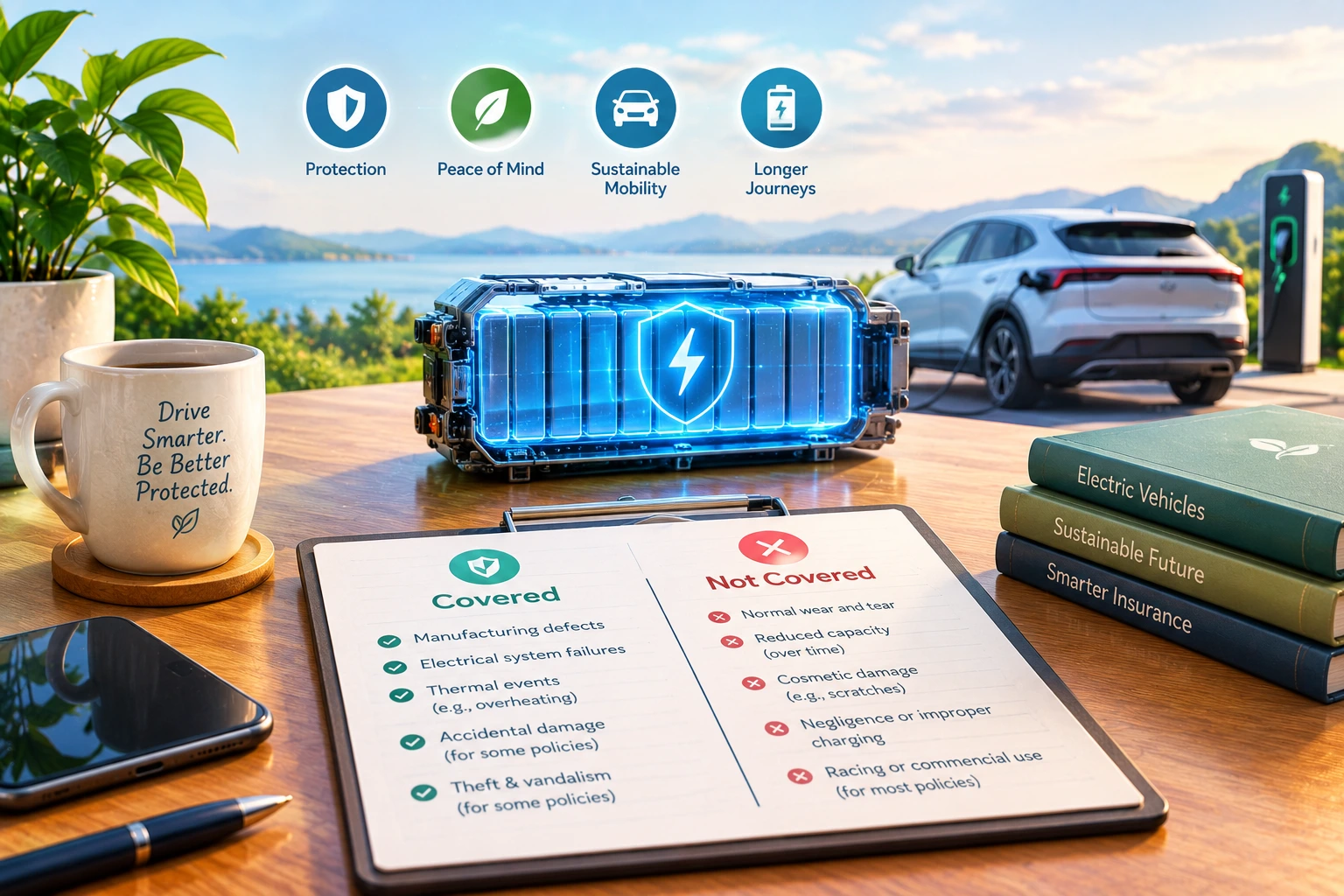
| Does NOT cover | Damage from accidents, unauthorized modifications, or failure to follow manufacturer service guidelines | Ordinary age- and charging-related degradation — that’s a warranty matter, not an insurable event |
The one-line version: if the battery slowly loses range over time, that’s your warranty’s problem while it’s still in-warranty, and your own cost afterward. If the battery is damaged in a crash, fire, flood, or theft, that’s your insurer’s problem — assuming you actually carry comprehensive/collision coverage rather than liability-only.
Per SoFi’s consumer finance breakdown of EV battery costs, federal law requires automakers to warranty EV and hybrid batteries for a minimum of eight years or 100,000 miles, whichever comes first, and manufacturers typically promise the battery will retain at least 70% of original capacity throughout that coverage period. Warranty terms generally exclude damage from accidents, unauthorized modification, or failure to follow the manufacturer’s service guidelines — which is exactly the gap comprehensive/collision auto insurance is designed to fill.
Replacement Costs, If You’re Ever Out of Warranty
Costs scale heavily with battery pack size and vehicle brand. Based on 2026 model pricing data compiled from manufacturer and industry sources:
| Vehicle | Battery Pack Size | Typical Replacement Cost |
|---|---|---|
| Nissan Leaf (40 kWh) | 40 kWh | $4,000–$6,500 |
| Chevy Bolt EV | 65 kWh | $11,000–$16,000 |
| Hyundai Ioniq 5 | 77 kWh | $14,000–$19,000 |
| Tesla Model 3 (Long Range) | 82 kWh | $17,000–$22,000 |
| Ford F-150 Lightning | 131 kWh | $25,000–$50,000 |
| Tesla Cybertruck / Rivian R1S/R1T | 123–135 kWh | $28,000–$50,000 |
Labor typically adds another $1,000–$4,000 on top of parts pricing, and independent EV repair shops often charge 30–50% less than dealerships for the same replacement job — worth calling around before assuming the dealer quote is your only option.
Why EVs Are More Likely to Be “Totaled” After an Accident
Because the battery pack represents such a large share of an EV’s total value, even moderate collision damage that reaches the pack can push repair costs past your insurer’s total-loss threshold faster than an equivalent repair would on a comparable gas vehicle. This is worth understanding before you buy, not after an accident: it’s a real, structural reason EV comprehensive and collision premiums often run higher than gas-vehicle premiums for a similarly priced car, and it’s a strong practical argument for gap insurance if you’re financing or leasing. Gap coverage pays the difference between what you still owe the lender and what the car is actually worth at the time it’s totaled — a gap that widens meaningfully on a vehicle where a single damaged battery pack can trigger total-loss status well before the rest of the car looks “totaled” to the naked eye.
If you want the underlying mechanics of exactly how insurers calculate a payout once a vehicle is declared a total loss — including how depreciation and actual cash value get factored in — our breakdown in Betterment Assessments Part 2: How Insurers Calculate What You Owe covers the general claims math that applies here too.
Regulatory Backstop: California’s Advanced Clean Cars II Rule
Beginning with 2026 model-year vehicles, California’s Advanced Clean Cars II regulation requires battery warranties to guarantee at least 70% state-of-health retention for 10 years or 150,000 miles — meaningfully stricter than the federal 8-year/100,000-mile minimum. Several other states have formally adopted California’s vehicle emissions and battery durability standards, so this stronger warranty floor may already apply to your specific vehicle depending on where it was originally sold, even if you personally live somewhere else.
Questions to Ask Your Insurer Before You Buy
- Do you carry a specific EV or battery endorsement, or is battery damage simply handled under standard comprehensive/collision coverage?
- What’s your total-loss threshold specifically, and how does it treat battery-pack damage versus body damage?
- Is gap insurance available as an add-on, and does it explicitly name battery-related total losses in its terms?
- Does my policy price differently for EVs versus comparable gas vehicles, and if so, why — ask for the specific rating factor.
How This Fits Into Your Broader Auto Coverage Strategy
EV battery risk is really one piece of a bigger picture: how modern car insurance increasingly factors in technology, not just traditional collision risk. If your EV also participates in a usage-based or telematics program, our guide to Usage-Based Car Insurance 2026: How Telematics Programs Actually Work covers how that data affects pricing separately from battery-specific coverage. And if you’re specifically concerned about what your car’s connected systems are sharing with your insurer, Telematics Insurance Privacy Risks: Is Your Car Tracking Too Much Data? is worth reading alongside this one.
Frequently Asked Questions
Will my car insurance pay to replace a battery that’s just degraded with age?
No. Gradual degradation from normal age and charging is a warranty issue, not an insurable event. Insurance only pays out for a covered loss like an accident, theft, fire, or flood — ordinary capacity loss over time falls entirely under your manufacturer’s warranty, if you’re still within its term.
Does liability-only car insurance cover my own EV battery?
No. Liability-only coverage exclusively pays for damage or injury you cause to other people or their property — it never pays to repair or replace your own vehicle or battery under any circumstances. You need comprehensive and/or collision coverage specifically to have any protection for your own battery.
Is gap insurance worth it specifically for EVs?
Often yes, more so than on a comparable gas vehicle, because a damaged battery pack can push an EV into “total loss” territory faster and at a lower dollar threshold than body damage alone would on a gas car — a direct result of how much of the vehicle’s overall value the battery represents. If you’re financing or leasing, this makes the payout gap between what you owe and the car’s assessed value meaningfully more likely to matter.
Do all EV manufacturers offer the same battery warranty terms?
No. While federal law sets an 8-year/100,000-mile minimum, warranty length, mileage caps, and the guaranteed minimum capacity (“state of health”) floor vary by manufacturer and even by model within the same brand. Some manufacturers offer 10-year coverage; always check the specific published warranty booklet for your exact model rather than assuming the federal minimum is what you’ll get.
If I buy a used EV, does the original battery warranty transfer to me?
Usually yes, but not universally, and terms can differ for second or third owners. Before buying a used EV, verify the vehicle’s in-service date, how much of the original warranty period remains, and explicitly confirm with the manufacturer or a dealer whether the remaining coverage transfers in full to a subsequent owner.
Does fast charging void my EV battery warranty?
Normal use of manufacturer-approved fast charging typically does not void your warranty, but heavy reliance on DC fast charging is associated with faster real-world degradation — industry fleet data shows batteries charged primarily via DC fast charging degrading at roughly double the rate of those charged primarily at home on AC power. This affects how much capacity you retain over time, not your warranty eligibility, unless your specific manufacturer’s terms state otherwise.
Conclusion
The real story isn’t “EV batteries are risky” — it’s that outright battery failure is rare, degradation is slow and largely predictable, and the two systems that actually protect you, warranty and insurance, cover completely different scenarios that don’t overlap. Knowing which one applies to which situation is more useful in practice than any single statistic about battery lifespan, because it tells you exactly who to call when something actually goes wrong.
Before you buy or renew a policy, confirm your insurer’s total-loss threshold in writing and ask directly whether gap coverage is available and explicitly applies to battery-related losses. That’s the one place EV owners are most likely to be caught off guard financially, and it’s also the single easiest thing on this entire list to fix in advance, before you ever need it.